
Why Amalfi Coast Drive – Should Be on Your Bucket List

Driving the Amalfi Coast | A Once-in-a-Lifetime Italian Road Trip

Driving the Amalfi Coast isn’t just a trip—it’s a once-in-a-lifetime experience that stays with you long after the engine is turned off. This legendary stretch of coastline in southern Italy is where dramatic landscapes, timeless villages, and the romance of the open road come together in perfect harmony.

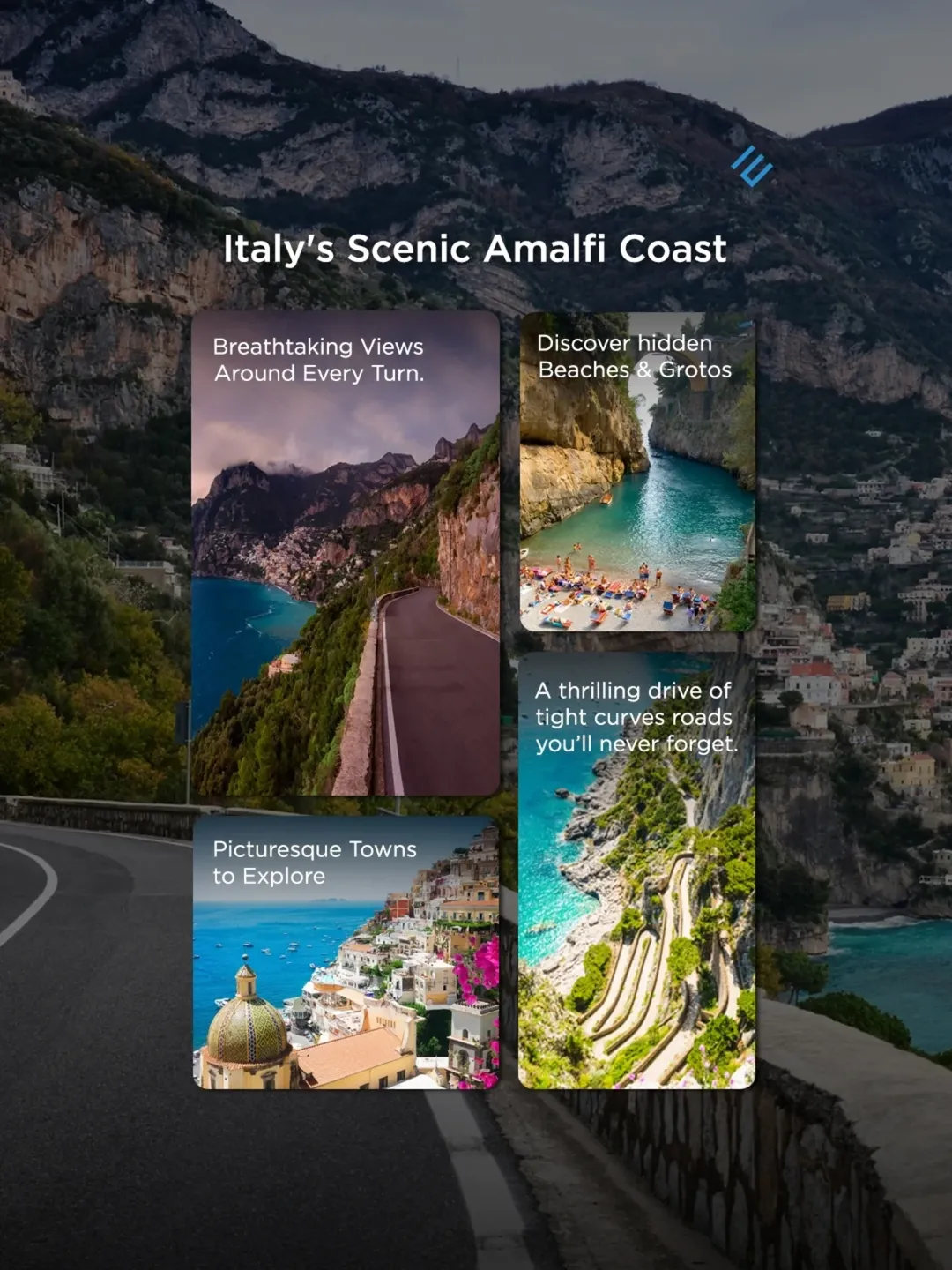
Imagine winding roads carved into towering cliffs, the Tyrrhenian Sea sparkling far below, and colorful villages stacked like paintings on the hillsides. Add the scent of lemon trees drifting through the air and the sound of waves echoing against rock walls, and you begin to understand why the Amalfi Coast is considered one of the most beautiful drives in the world.

Every turn reveals a postcard view.
Every stop becomes a memory worth keeping.

Amalfi Coast
Amalfi Coast

A Coastline Shaped by Nature and Time

The Amalfi Coast stretches along the southern edge of the Sorrentine Peninsula, where steep mountains plunge directly into the sea. Unlike wide highways designed for speed, the coastal road here was built to follow the land, not dominate it. Curves wrap tightly around cliffs, tunnels cut through solid rock, and viewpoints appear suddenly, demanding your attention.

This dramatic geography is what gives the Amalfi Coast its unmistakable character. The road feels alive—sometimes narrow, sometimes daring—but always rewarding. Driving here is not about rushing from point A to point B. It is about slowing down and letting the landscape guide you.

The Romance of the Open Road

There is something deeply romantic about driving the Amalfi Coast. Perhaps it’s the way sunlight dances across the water, or how the road seems to float between sea and sky. Perhaps it’s the freedom to stop whenever a view captures your heart.

Unlike train journeys or guided tours, a road trip allows you to experience the coast on your own terms. You decide when to pause, where to linger, and how long to stay. A scenic overlook becomes a photo stop. A small café becomes an afternoon escape. A quiet beach becomes an unexpected highlight.

This sense of spontaneity is what transforms a drive into an experience.

Villages That Feel Like Living Paintings

Scattered along the cliffs are villages that feel almost unreal in their beauty. Positano, with its pastel houses cascading toward the sea, is often the first image people associate with the Amalfi Coast. Seeing it from the road—suddenly revealed after a bend—is breathtaking.

Further along, Amalfi offers historic charm, lively piazzas, and a deep connection to the region’s maritime past. High above the coastline, Ravello provides sweeping views and a calmer pace, where gardens and terraces overlook the endless blue horizon.

Each village has its own rhythm, personality, and story. Driving allows you to experience them not as isolated stops, but as part of a flowing narrative along the coast.

The Scent and Flavor of the Amalfi Coast

One of the most unforgettable aspects of this journey is not just what you see—but what you smell and taste. Lemon trees line terraces and roadsides, producing the famous Amalfi lemons used in refreshing limoncello and local desserts. The scent is fresh, citrusy, and unmistakably Mediterranean.

Stopping at a small trattoria along the way often means enjoying simple yet extraordinary food: fresh seafood, handmade pasta, local olive oil, and wine produced on steep hillside vineyards. Meals feel unhurried, meant to be savored alongside the view.

Here, food is not just nourishment—it’s part of the journey.

Every Turn Tells a Story

The road itself, often referred to as the Strada Statale 163, is legendary. Built into the cliffs, it connects village after village in a continuous ribbon of scenery. Some sections feel thrilling, others serene, but none are ordinary.

At times, you’ll pass local buses navigating tight corners with practiced precision. At others, you’ll slow down behind scooters or pause to let another car pass. Rather than frustration, these moments add authenticity. They remind you that this road is part of daily life, not just a tourist attraction.

Driving the Amalfi Coast teaches patience—and rewards it generously.

When to Drive the Amalfi Coast

Timing plays a crucial role in shaping the experience. Spring and early summer bring blooming landscapes and comfortable temperatures, while autumn offers softer light and fewer crowds. Evenings can be magical, as golden hour transforms the coast into a glowing masterpiece.

Driving earlier in the day allows you to enjoy quieter roads and clearer views, while late afternoons invite leisurely stops and sunset moments. No matter the season, the Amalfi Coast demands presence. This is not a drive to rush—it’s one to feel.

More Than a Scenic Route

What makes the Amalfi Coast truly special is that it is more than a scenic route—it is a journey of emotion. It combines freedom, beauty, and discovery in a way few destinations can. The road doesn’t just take you through landscapes; it takes you through moods.

Excitement builds as cliffs grow steeper. Calm settles in when the sea opens wide before you. Joy appears in small, unexpected moments—a quiet village square, a roadside café, a hidden beach glimpsed from above.

This is why so many travelers describe driving the Amalfi Coast as transformative.

Why This Road Trip Belongs on Your Italy List

Italy offers countless unforgettable experiences, but few compare to the Amalfi Coast by car. It represents a different side of travel—one rooted in exploration rather than schedules, and connection rather than checklists.

Driving the Amalfi Coast offers:

  • Iconic coastal views at every turn

  • Freedom to explore at your own pace

  • Access to villages, viewpoints, and hidden gems

  • A deep sensory experience through sights, sounds, and flavors

  • Memories that feel personal and cinematic

It is Italy at its most emotional and immersive.

A Journey That Stays With You

Long after the trip ends, memories of the Amalfi Coast linger. You remember the sound of the sea far below the road, the glow of villages at sunset, and the feeling of driving between sky and water. These moments become part of your travel story—ones you’ll revisit again and again.

If you ever needed a sign to plan your Italy road trip, this is it.

Because driving the Amalfi Coast isn’t just about reaching a destination.
It’s about embracing the journey—and letting Italy reveal itself, one breathtaking curve at a time.
Lofoten Island

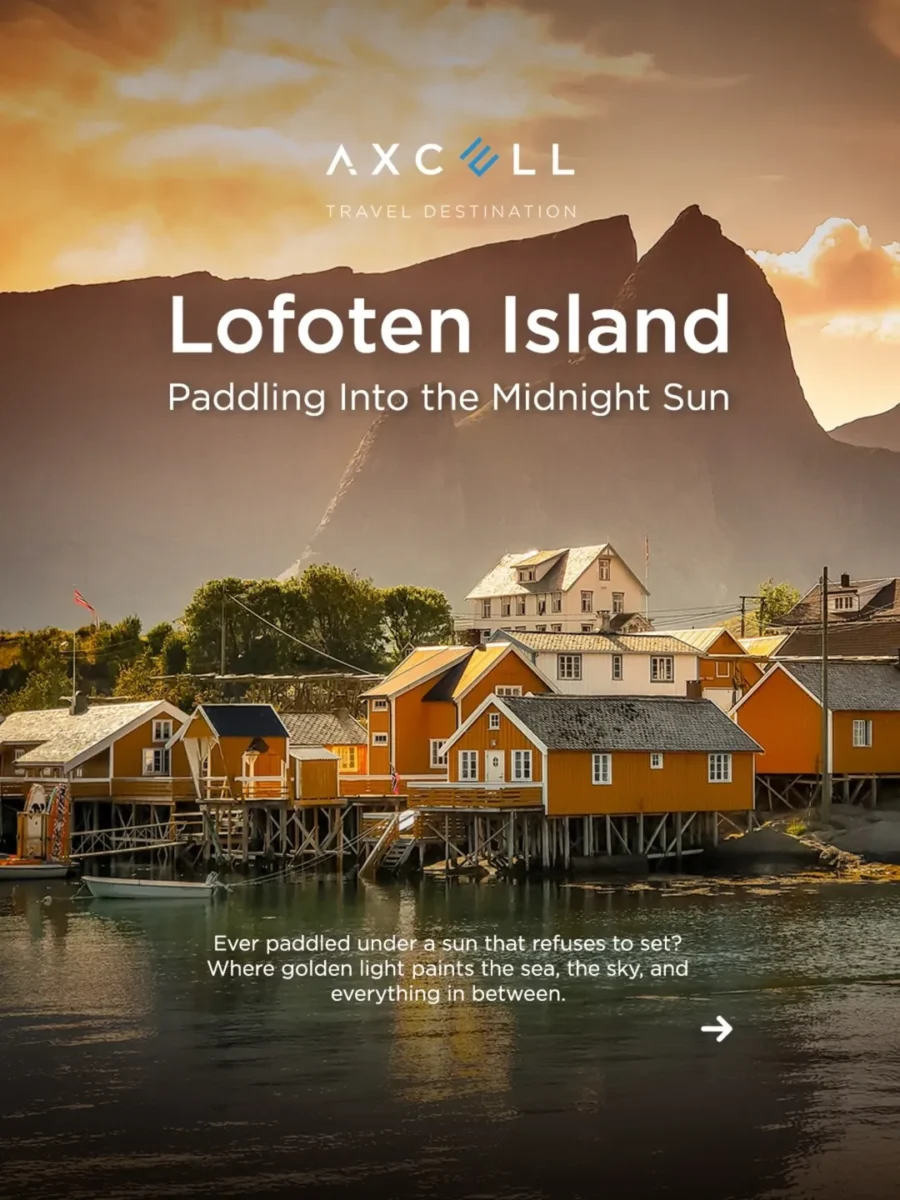
Lofoten Island – Padding Into the Midnight Sun

Ever Kayaked at Midnight… with the Sun Still Shining?

A golden Arctic dream in Norway’s Lofoten Islands

Imagine gliding silently across calm water at midnight—no darkness, no stars, no sense of time slipping away. The sky glows in soft shades of gold and amber, mountains rise like silhouettes from the sea, and every ripple reflects sunlight that refuses to fade. This is not a fantasy. This is the Midnight Sun in the Lofoten Islands, one of the most magical places on Earth to experience it.

Located above the Arctic Circle in Norway, the Lofoten Islands transform the very idea of night. From May to July, the sun never fully sets, turning late hours into a dreamlike extension of day. And there may be no better way to experience this phenomenon than from the water—kayaking beneath a sun that lingers long past midnight.

Lofoten Island
Lofoten Island

The Midnight Sun - When Time Loses Meaning

The Midnight Sun occurs in regions north of the Arctic Circle, where the Earth’s tilt allows the sun to remain visible for 24 hours a day during summer months. In the Lofoten Islands, this creates a unique rhythm of life—one where night never truly arrives.

Instead of darkness, the sky shifts gently through layers of color. At midnight, the sun hangs low on the horizon, bathing fjords and beaches in warm, golden light. Shadows stretch long, reflections sharpen, and the world feels suspended between day and dream.

For visitors, this phenomenon is both exhilarating and disorienting. Without sunset to mark the end of the day, time becomes fluid. You no longer ask what hour it is—you simply follow the light.

Why the Lofoten Islands Feel So Magical

The Lofoten Islands are dramatic even without the Midnight Sun. Jagged peaks rise abruptly from the sea, fishing villages cling to rocky shores, and turquoise waters rival those of tropical destinations—despite the Arctic latitude. In summer, green slopes replace snow, wildflowers dot the landscape, and the air feels crisp yet gentle.

What makes Lofoten truly special is contrast: rugged mountains paired with calm waters, remote wilderness alongside small, welcoming communities, and raw nature softened by glowing summer light. When the Midnight Sun is added to this scenery, the effect becomes almost surreal.

At midnight, the islands feel quieter, more intimate. Boats rest in harbors, seabirds glide across still water, and the golden light wraps everything in calm.

Kayaking at Midnight - A Once-in-a-Lifetime Experience

Kayaking beneath the Midnight Sun is not about adrenaline—it’s about atmosphere. As you paddle across fjords or along the coastline, the world feels hushed and expansive. The water is often mirror-like, reflecting the sun, the mountains, and the sky so clearly that it feels as though you are floating through light itself.

There is something deeply peaceful about moving slowly across the sea at an hour usually reserved for sleep. No crowds. No noise. Just the gentle rhythm of paddles dipping into water and the soft glow of endless daylight.

Many travelers describe midnight kayaking in Lofoten as meditative. The experience invites stillness, reflection, and a sense of connection to nature that is difficult to find elsewhere.

A Different Kind of Arctic Adventure

When people think of Arctic travel, they often imagine snow, ice, and extreme cold. The Lofoten Islands in summer challenge that perception entirely. Temperatures are cool but comfortable, daylight is abundant, and outdoor activities feel accessible rather than intimidating.

Midnight kayaking is part of a broader summer lifestyle in Lofoten. Hiking at unusual hours, sitting on beaches late into the night, or photographing landscapes under golden skies becomes normal. Locals and visitors alike adapt to the sun’s presence, embracing a slower, more intuitive rhythm.

In this environment, adventure doesn’t mean rushing—it means savoring.

Light That Transforms Everything

Photographers and artists are drawn to the Lofoten Islands for a reason. The Midnight Sun creates light unlike anywhere else in the world. It is soft yet vibrant, warm yet crisp. Colors feel richer, textures more defined, and scenes more cinematic.

From the water, this light becomes even more powerful. Mountains appear layered and dimensional. Reflections double the landscape. Even simple moments—like drifting in place, paddle resting on the kayak—feel elevated by the glow surrounding you.

This is not dramatic light.
It is emotional light.

Who Is This Experience For?

Midnight kayaking in Lofoten is not reserved for extreme adventurers. It appeals to travelers who value unique experiences, quiet beauty, and meaningful moments.

It is ideal for:

  • Nature lovers seeking something extraordinary

  • Travelers building an Arctic bucket list

  • Couples looking for a romantic, unforgettable experience

  • Solo travelers drawn to reflection and calm

  • Photographers chasing rare light

You don’t need to paddle fast or far. Simply being there is enough.

Beyond Kayaking - A Summer That Never Sleeps

While midnight kayaking may be the highlight, the Midnight Sun shapes every aspect of summer life in Lofoten. Hiking trails remain visible late into the night. Fishing villages glow under low-hanging sun. Beaches feel otherworldly at 1:00 a.m., when the light suggests afternoon but the silence suggests dawn.

Sleep becomes optional. Wonder becomes constant.

This is what makes Lofoten so unforgettable—not just what you do, but how the world feels while you do it.

Why This Belongs on Your Arctic Bucket List

Some travel experiences are impressive. Others are transformative. Kayaking under the Midnight Sun in the Lofoten Islands belongs firmly in the second category.

What makes it truly special:

  • The sun never sets, even at midnight

  • Calm Arctic waters reflect endless golden light

  • Dramatic mountain and fjord scenery

  • A peaceful, uncrowded atmosphere

  • A rare sense of timelessness

It is calm, surreal, and completely unforgettable.

A Memory That Stays with You

Long after you leave Norway, this experience lingers. You remember the stillness of the water, the warmth of light at an impossible hour, and the quiet realization that the world is far larger—and more magical—than everyday life suggests.

Midnight kayaking in the Lofoten Islands is not just something you do.
It’s something you feel.

🌞🚣‍♀️ Ever kayaked at midnight with the sun still shining?
If not, save this for your Arctic bucket list—because some journeys don’t follow the clock… they follow the light.

Dolomites Trekking

Dolomites Trekking – Welcome to Italy’s Summer Wonderland

Dolomites Trekking – Italy’s Summer Wonderland

Where fresh air, dramatic peaks, and slow mountain living redefine your Italian escape

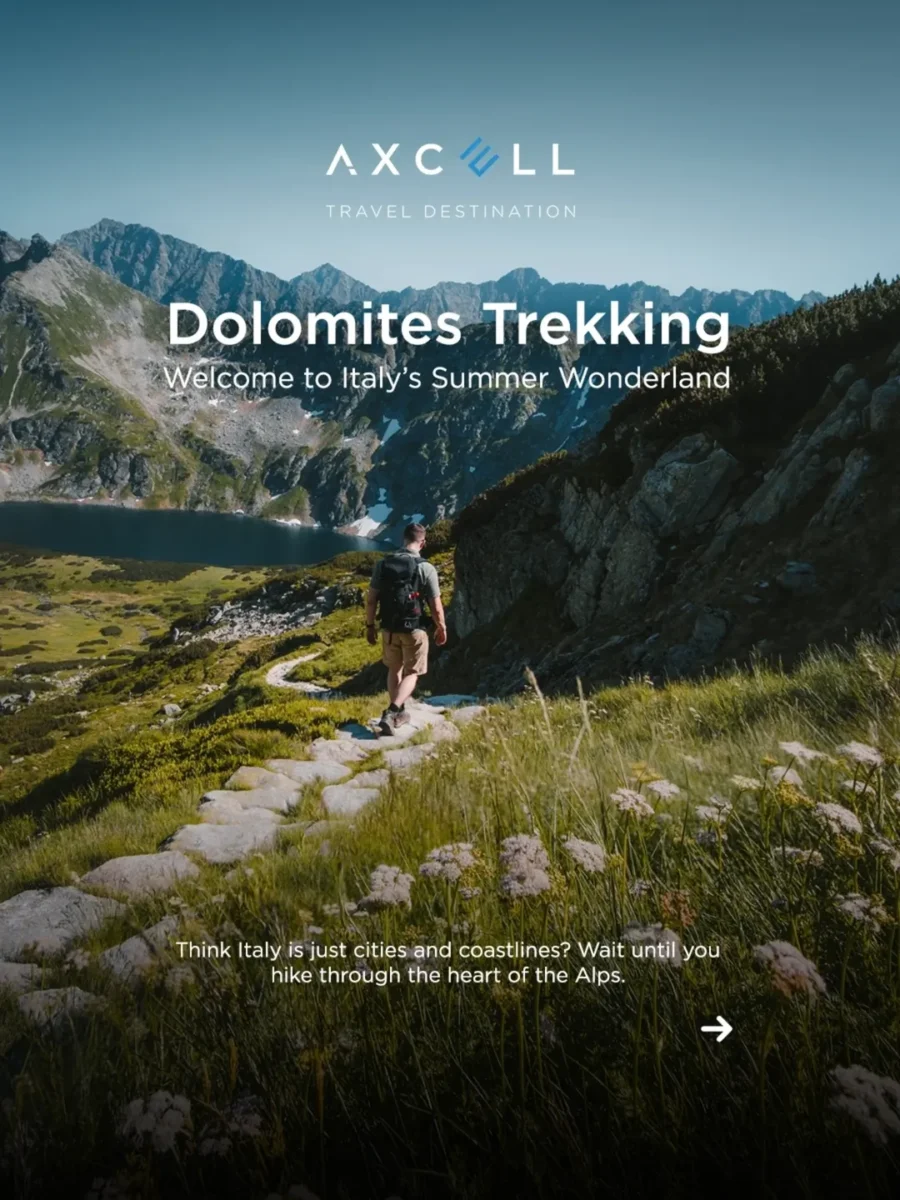
When people think of Italy, images of Rome’s ancient ruins, Venice’s canals, or Tuscany’s rolling vineyards often come to mind. But beyond the famous cities and coastlines lies a completely different side of Italy—one that feels quieter, wilder, and deeply refreshing. Welcome to the Dolomites, a summer wonderland where jagged peaks pierce blue skies, alpine trails bloom with wildflowers, and cozy mountain huts serve pasta and wine at the end of a perfect hiking day.

If you’re looking to skip the usual Italy and experience something more immersive, the Dolomites deserve a place at the very top of your summer travel list.

Dolomites Trekking
Dolomites Trekking
Dolomites Trekking

A Landscape Unlike Anywhere Else in Italy

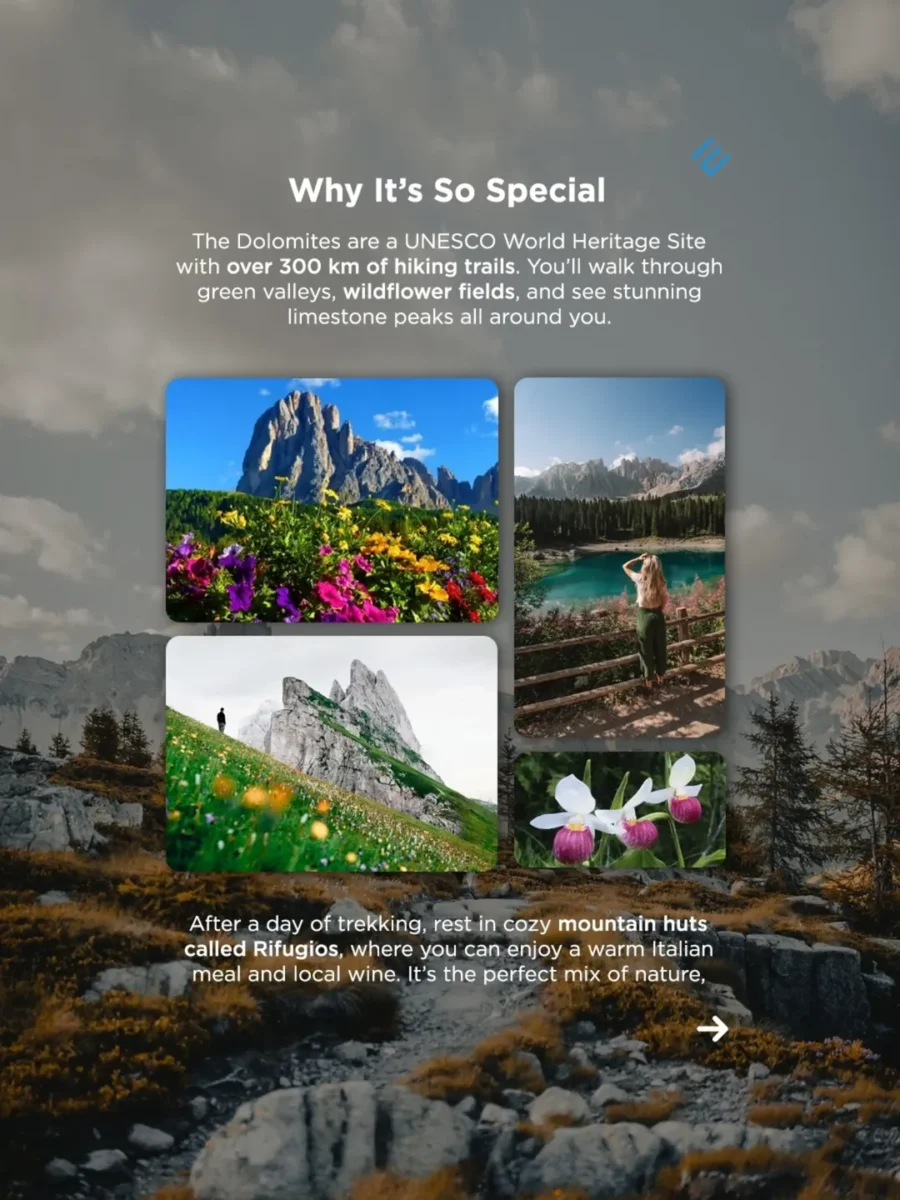
The Dolomites are instantly recognizable. Their dramatic limestone peaks rise sharply from green valleys, glowing pink and gold at sunrise and sunset—a phenomenon known as enrosadira. This unique geology sets the Dolomites apart from other mountain ranges in Europe, creating landscapes that feel almost surreal.

In summer, snow retreats from the trails, revealing rolling meadows, turquoise alpine lakes, and panoramic ridgelines. The air feels crisp and clean, the pace of life slows, and nature becomes the main attraction. It’s a place where every step feels scenic and every pause rewards you with a view worth remembering.

Why Summer Is the Best Time to Visit

While the Dolomites are famous for winter skiing, summer reveals their most accessible and diverse side. From June to September, the mountains transform into a trekking paradise suitable for both beginners and experienced hikers.

Trails are well-marked, cable cars make high-altitude access easy, and the weather is generally mild—cool mornings, warm afternoons, and refreshing evenings. Summer is also when wildflowers blanket the slopes, adding bursts of color to an already stunning landscape.

Unlike Italy’s cities, which can feel crowded and hot during peak season, the Dolomites offer space, serenity, and breathing room.

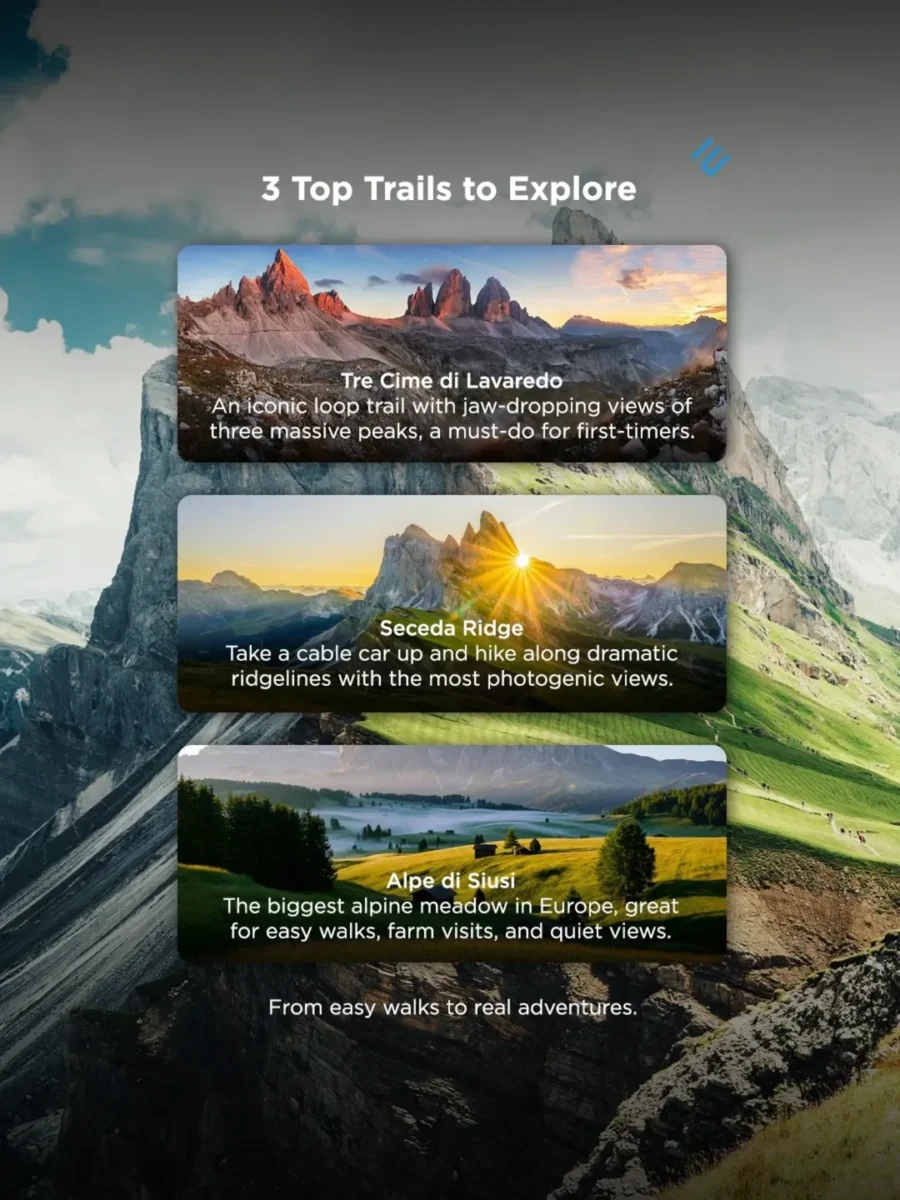
Tre Cime di Lavaredo - The Iconic Hike

No discussion of Dolomites trekking is complete without mentioning Tre Cime di Lavaredo. These three towering peaks are among the most famous mountain formations in Europe—and for good reason.

The Tre Cime loop trail is one of the most rewarding hikes in the region. Accessible yet dramatic, it offers sweeping views, manageable terrain, and constant visual impact. Walking beneath the sheer rock faces of Tre Cime feels humbling and exhilarating at the same time.

Despite its popularity, the area still retains a sense of grandeur and openness, especially in the early morning or late afternoon when crowds thin and the mountains reclaim their quiet presence.

Beyond the Famous Trails - Hidden Alpine Gems

While Tre Cime draws global attention, the true magic of the Dolomites often lies off the beaten path. Countless lesser-known trails wind through peaceful valleys, remote plateaus, and secluded mountain passes where you may walk for hours accompanied only by cowbells and the sound of wind through grass.

These hidden alpine gems offer a deeper connection to the landscape. Trails lead past crystal-clear streams, through forests scented with pine, and up to viewpoints that feel completely untouched. This is where the Dolomites reveal their soul—quiet, expansive, and profoundly grounding.

Rifugios - Where Trekking Meets Italian Comfort

One of the most charming aspects of trekking in the Dolomites is the mountain huts, known as rifugios. Unlike basic shelters found in many hiking regions, Dolomites rifugios combine alpine simplicity with unmistakable Italian warmth.

After a day on the trail, you can sit on a sunny terrace with a plate of fresh pasta, local cheese, or hearty soup—often paired with a glass of wine or espresso. Some rifugios even offer overnight stays, allowing you to wake up above the clouds as morning light touches the peaks.

This blend of nature and comfort is what makes trekking in the Dolomites so special. Adventure doesn’t mean sacrificing pleasure—it enhances it.

A Trek for Every Traveler

The Dolomites are incredibly versatile. Whether you’re seeking gentle walks, panoramic day hikes, or multi-day trekking routes, there’s something here for every fitness level and travel style.

Beginners can enjoy scenic valley walks and cable-car-assisted hikes, while more experienced trekkers can tackle high-altitude routes and longer crossings. Families, couples, and solo travelers all find their rhythm here, united by the shared joy of being surrounded by extraordinary nature.

More Than Hiking - A Lifestyle Experience

Trekking in the Dolomites isn’t just about reaching summits—it’s about embracing a slower, more intentional way of traveling. Days are shaped by daylight, weather, and appetite. Evenings are quiet, filled with conversation, good food, and mountain views that linger in memory.

The region also reflects a fascinating blend of Italian and Alpine culture, especially in areas influenced by Austrian heritage. You’ll hear multiple languages, taste unique regional dishes, and experience traditions shaped by centuries of mountain living.

Why the Dolomites Should Top Your Summer Travel List

The Dolomites offer something increasingly rare in modern travel: space to breathe. They provide contrast to busy cities, depth beyond sightseeing, and beauty that feels earned through movement and presence.

Highlights of a Dolomites summer journey include:

  • Dramatic alpine landscapes and iconic peaks

  • Well-maintained trails for all experience levels

  • Cozy rifugios with authentic Italian food

  • Cooler temperatures and fresh mountain air

  • A slower, more meaningful travel rhythm

This is Italy reimagined—wild, peaceful, and profoundly scenic.

Trek Stress-Free, Experience More

Planning a Dolomites trekking trip involves choices—routes, accommodations, timing, transport, and daily pacing. Done right, it becomes seamless and deeply rewarding. Done poorly, it can feel overwhelming.

That’s why thoughtful planning matters.

From famous hikes like Tre Cime di Lavaredo to hidden alpine trails known only to locals, a well-designed itinerary ensures you experience the best of the Dolomites without stress—just fresh air, epic views, and unforgettable moments.

Ready for Your Dolomites Adventure?

If the idea of trading city crowds for mountain trails and cozy huts speaks to you, it might be time to rethink your Italian summer. The Dolomites are waiting—quiet, dramatic, and endlessly beautiful.

📩 DM us to plan your Dolomites adventure.
No stress. No rush. Just Italy’s summer wonderland, crafted around you.

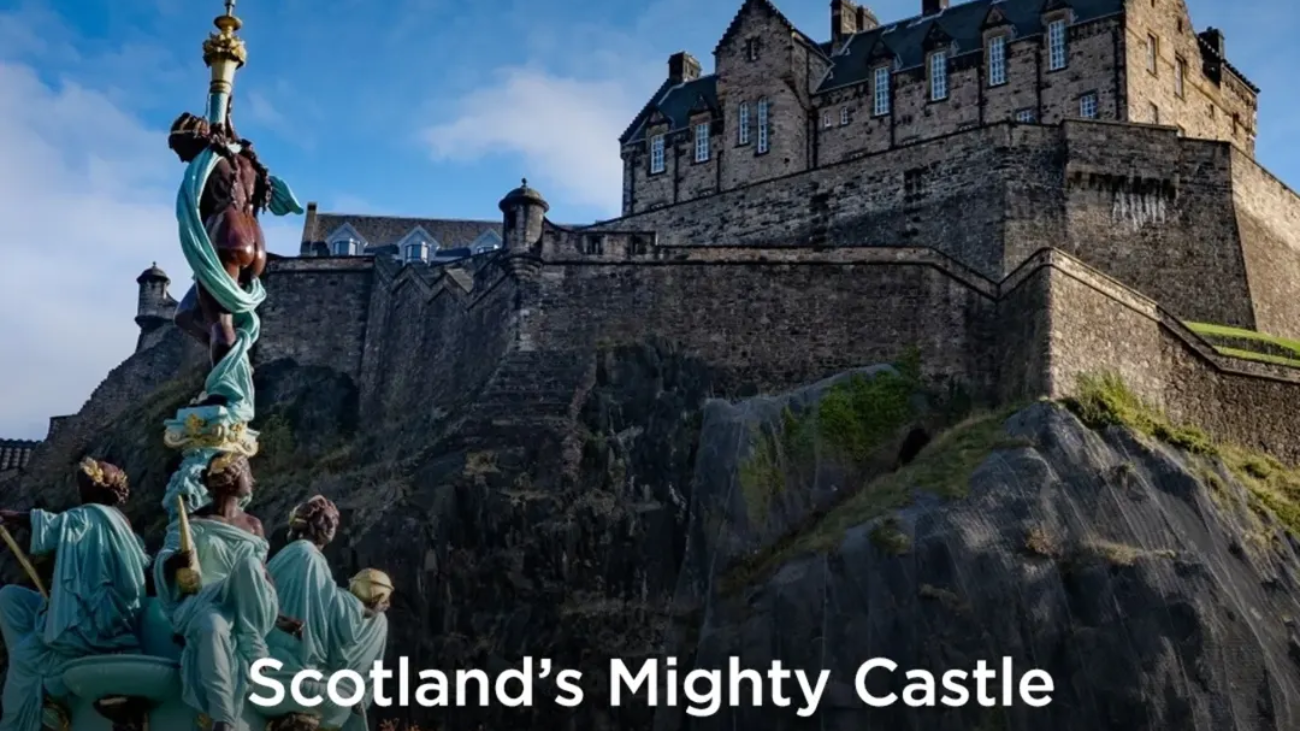
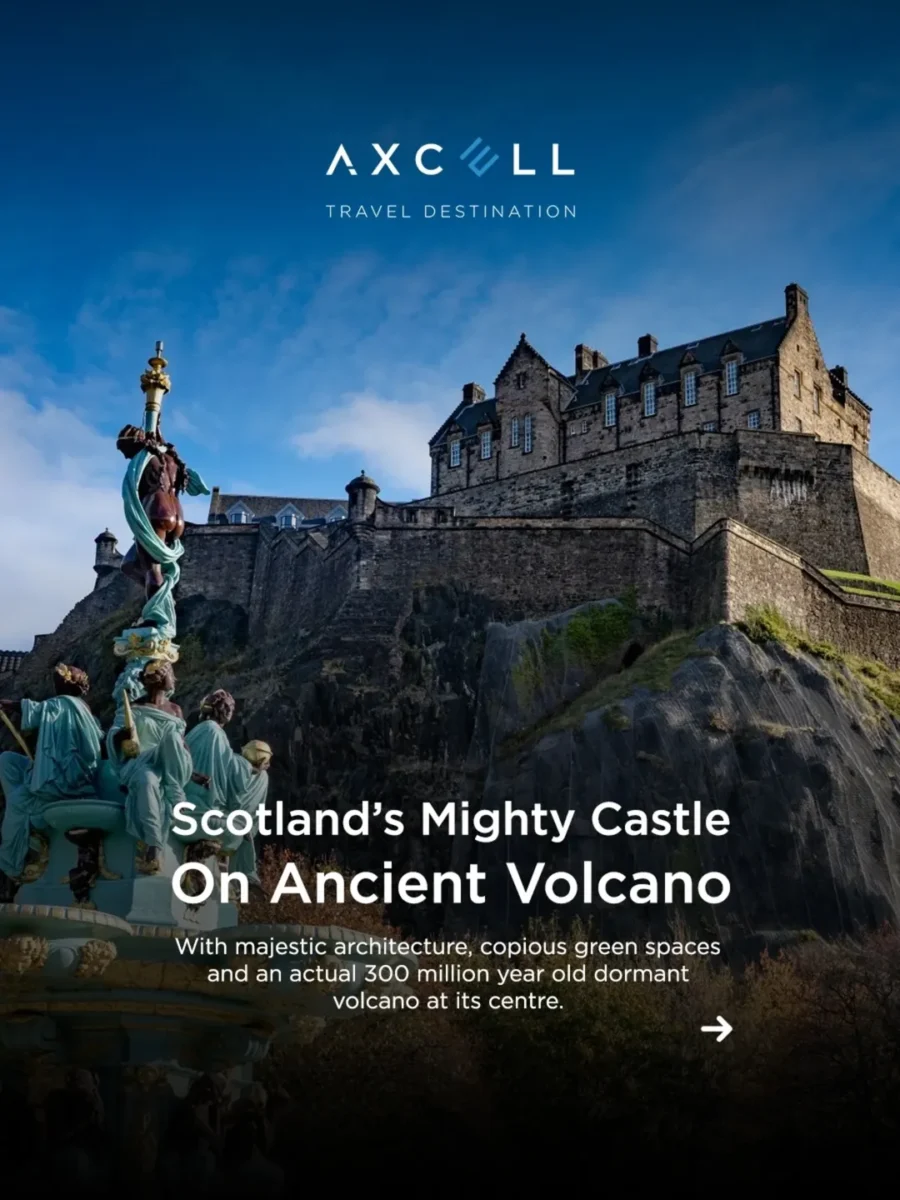
Scotland’s Mighty Castle On Ancient Volcano

Scotland’s Mighty Castle On Ancient Volcano

Built on a Volcano, Attacked 26 Times, and Still Standing Strong

Edinburgh Castle: Scotland’s Crown Jewel of Power, History, and Resilience

Perched high above the city skyline, commanding attention from nearly every corner of the capital, Edinburgh Castle is more than just a landmark—it is the beating heart of Scotland. Built atop an extinct volcano, attacked no fewer than 26 times, and still standing strong after centuries of conflict, Edinburgh Castle is one of the most dramatic and symbolically powerful fortresses in the world.

This is not simply a castle you visit.
It is a place you feel—layered with battles, royalty, rebellion, and tradition that echo through its ancient stone walls.

Scotland’s Mighty Castle On Ancient Volcano

A Fortress Forged by Fire and Stone

Edinburgh Castle rises from Castle Rock, the solid core of an extinct volcano that erupted more than 300 million years ago. This natural foundation gave the castle its most defining advantage: near-impenetrable defenses. With sheer cliffs on three sides, Castle Rock made direct assaults nearly impossible, turning the site into one of the most strategically valuable strongholds in Britain.

Long before the castle’s current structures took shape, the rock itself was recognized as a place of power. Human settlement here dates back over 2,000 years, but it was during the medieval period that Edinburgh Castle emerged as a symbol of dominance, survival, and sovereignty.

Its location was no accident. Whoever controlled the castle controlled Scotland.

A History Written in Conflict

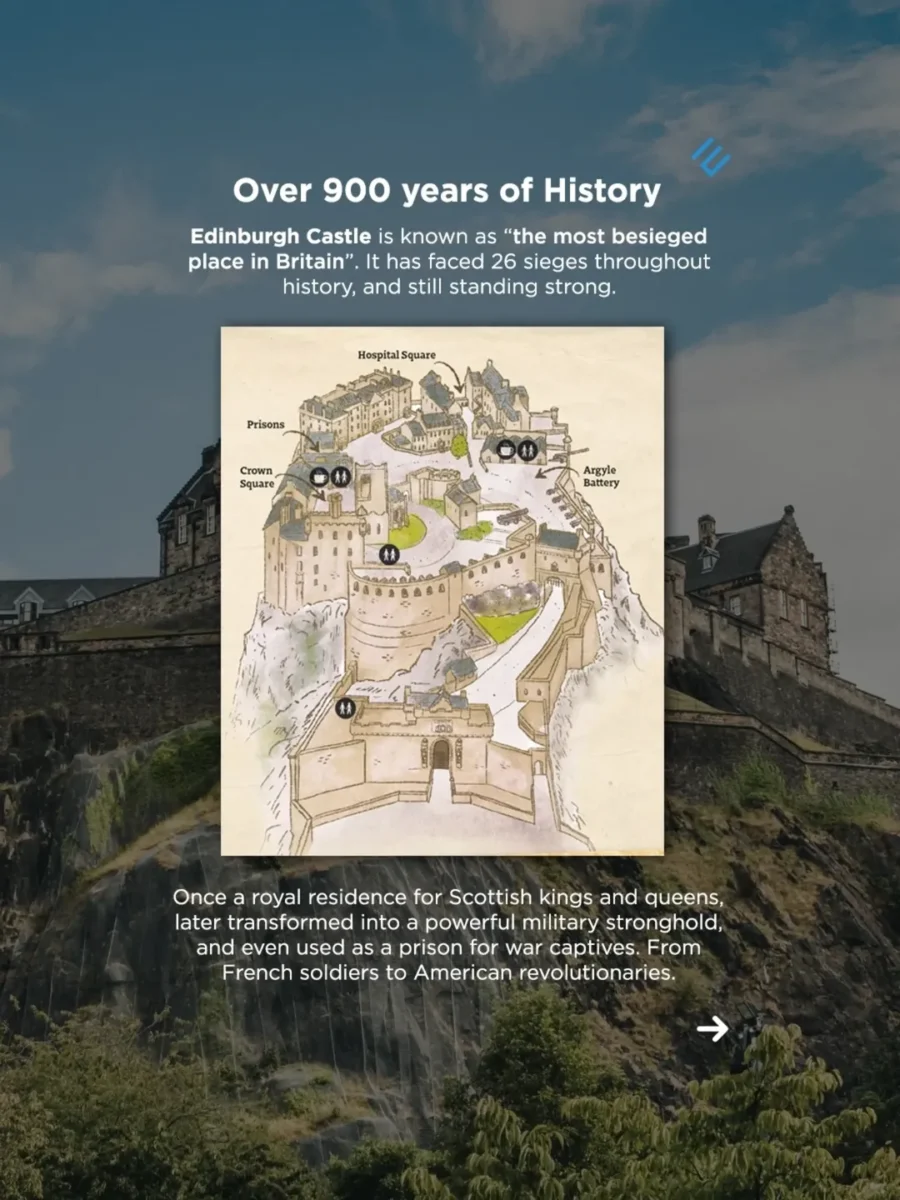
Edinburgh Castle holds the record as the most besieged place in Great Britain, having been attacked at least 26 times throughout its history. These were not minor skirmishes—many were decisive moments in Scotland’s turbulent past.

From wars with England to internal struggles for the Scottish crown, the castle stood at the center of conflict. It changed hands multiple times during the Wars of Scottish Independence, witnessing battles that shaped the nation’s identity. Each siege left its mark, strengthening the castle’s reputation as a fortress that could be challenged—but never easily defeated.

Despite relentless attacks, political upheaval, and centuries of warfare, Edinburgh Castle endured. Its survival is not just architectural—it is symbolic of Scotland’s resilience and determination.

Home of Scottish Royalty and National Treasures

Beyond its military importance, Edinburgh Castle also served as a royal residence. Kings and queens once lived within its walls, including Mary, Queen of Scots, who gave birth to James VI of Scotland here in 1566—later to become James I of England, uniting the crowns.

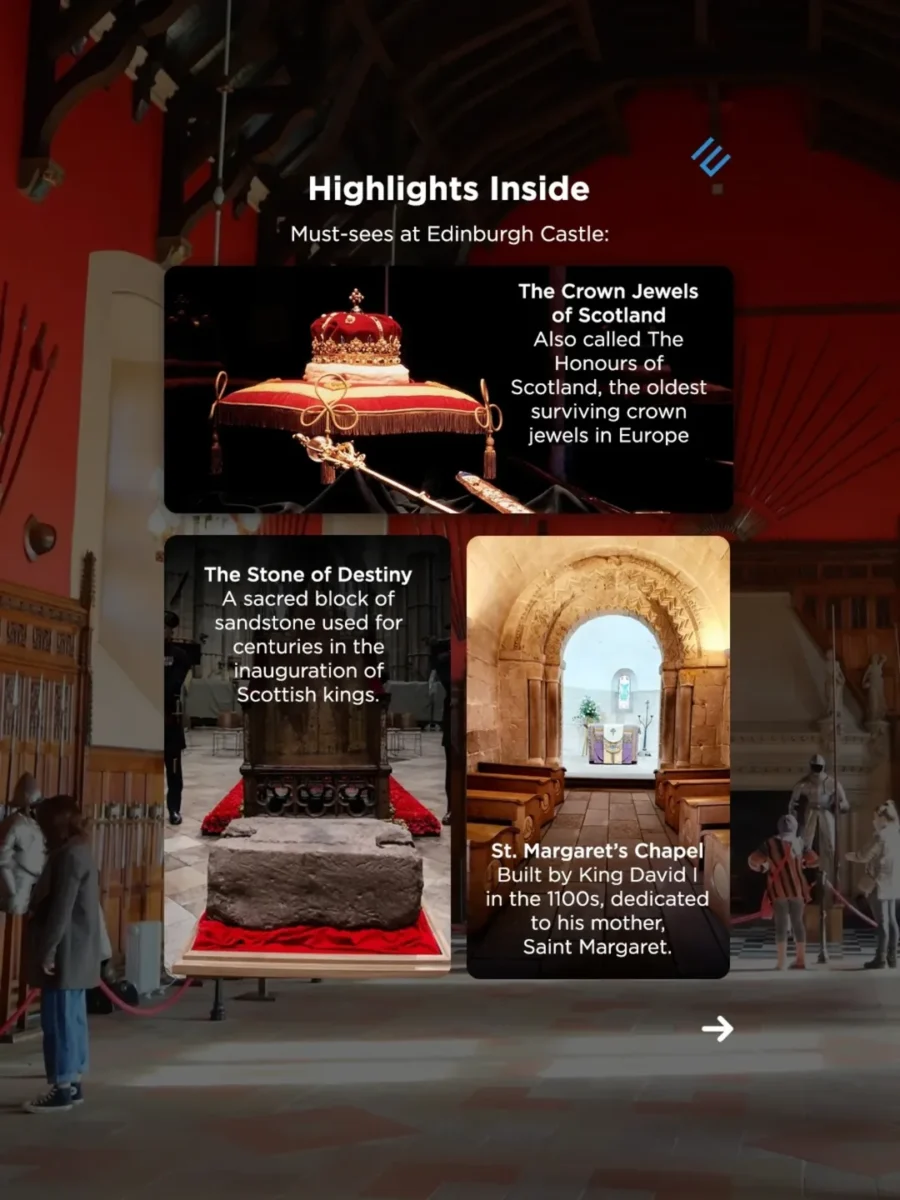
Inside the castle are some of Scotland’s most treasured symbols of nationhood. The Honours of Scotland—the Scottish Crown Jewels—are proudly displayed, representing sovereignty, ceremony, and continuity. Nearby lies the Stone of Destiny, used for centuries in the coronation of Scottish monarchs and long contested by English kings.

These artifacts are not merely historical objects; they are embodiments of Scotland’s struggle for identity and independence.

Beyond its military importance, Edinburgh Castle also served as a royal residence. Kings and queens once lived within its walls, including Mary, Queen of Scots, who gave birth to James VI of Scotland here in 1566—later to become James I of England, uniting the crowns.

Inside the castle are some of Scotland’s most treasured symbols of nationhood. The Honours of Scotland—the Scottish Crown Jewels—are proudly displayed, representing sovereignty, ceremony, and continuity. Nearby lies the Stone of Destiny, used for centuries in the coronation of Scottish monarchs and long contested by English kings.

These artifacts are not merely historical objects; they are embodiments of Scotland’s struggle for identity and independence.

A Living Military Stronghold

Although centuries have passed since its most violent days, Edinburgh Castle has never fully left military service. For generations, it functioned as an active garrison, prison, and storage site for weapons and supplies. Soldiers lived, trained, and prepared for war within its walls, reinforcing the castle’s reputation as a living fortress rather than a relic.

Today, this military legacy is preserved through museums and regimental displays, offering insight into Scotland’s martial history—from medieval warriors to modern regiments. Walking through the castle grounds, visitors move through layers of time, where each courtyard and hall reflects a different era of defense and duty.

The One O’Clock Gun - A Tradition That Still Roars

One of the most iconic experiences at Edinburgh Castle is the firing of the One O’Clock Gun. First introduced in 1861, the cannon is fired every day (except Sundays, Good Friday, and Christmas Day) precisely at 1:00 PM.

Originally, the gun served a practical purpose: helping ships in the Firth of Forth synchronize their marine chronometers. Today, it has become a beloved tradition—one that startles first-time visitors and delights locals year after year.

Hearing the cannon thunder across the city is a powerful reminder that Edinburgh Castle is not frozen in time. It is still alive, still speaking, still commanding attention.

Would you hear the One O’Clock Gun in person?

Architecture That Tells a Story

Unlike many castles designed with symmetry and elegance, Edinburgh Castle feels rugged, layered, and uncompromising. Its architecture reflects centuries of adaptation—buildings added, reinforced, and rebuilt as needs changed.

From the Great Hall, with its impressive hammerbeam roof, to St. Margaret’s Chapel—the oldest surviving building in Edinburgh—each structure contributes to the castle’s complex identity. This is architecture shaped by survival, not ornament.

Every stone feels purposeful. Every wall tells a story.

A View Worth Defending

Standing atop Edinburgh Castle, it becomes instantly clear why this site was fought over so fiercely. The panoramic views stretch across the city, from the historic Royal Mile to the distant hills beyond. On clear days, the landscape unfolds in all directions, offering a breathtaking sense of scale and perspective.

This commanding view is not just beautiful—it was once vital. From here, defenders could spot approaching enemies long before they reached the city gates. Today, visitors enjoy the same vantage point, not for defense, but for reflection and awe.

More Than a Castle—A National Symbol

Edinburgh Castle is not merely a tourist attraction. It is a symbol of Scotland itself—its strength, endurance, and pride. Through invasion, rebellion, and political change, the castle remained, adapting without surrendering its identity.

For Scots, it represents heritage and resilience. For visitors, it offers a profound connection to a nation shaped by struggle and spirit.

Why Edinburgh Castle Belongs on Your Travel List

Edinburgh Castle stands apart from castles that impress only with beauty. It impresses with meaning.

What makes it unforgettable:

  • Built atop an extinct volcano

  • One of the most attacked fortresses in history

  • Home to Scottish royalty and crown jewels

  • A living military tradition with the One O’Clock Gun

  • Sweeping views over one of Europe’s most atmospheric cities

This is history you don’t just read about—you walk through it.

Experience It for Yourself

No photograph or description can fully capture the power of standing within Edinburgh Castle’s walls, hearing the cannon fire, and feeling the weight of centuries beneath your feet. It is a place that transforms curiosity into understanding and admiration into respect.

If you are drawn to destinations where history is dramatic, layered, and alive, Edinburgh Castle deserves a place on your journey.

🏰 Would you hear the One O’Clock Gun in person?
Because some places don’t just tell stories—
they defend them, shape them, and carry them forward through time.

Derinkuyu

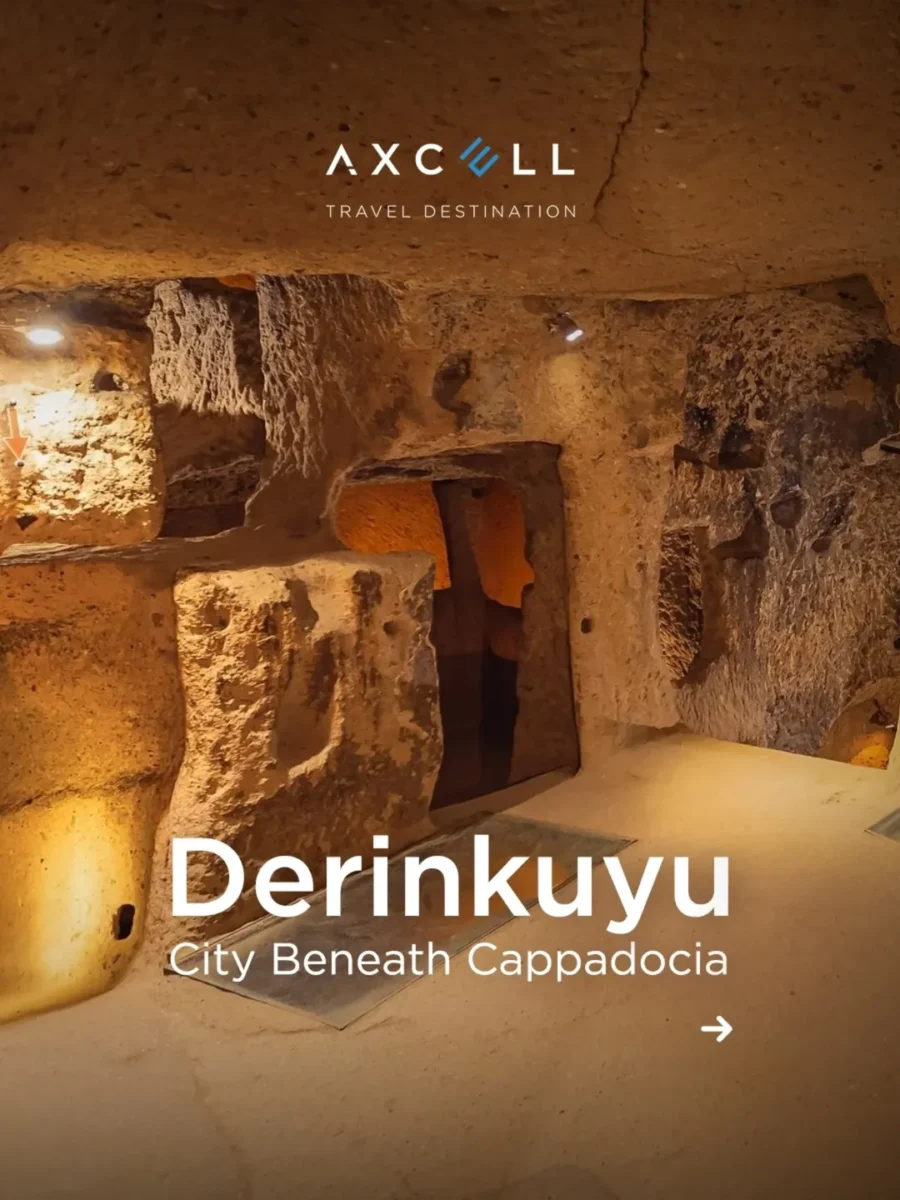
Derinkuyu – City Beneath Cappadocia

Step into a Hidden World Beneath Cappadocia

A journey through Derinkuyu, where history descends deep underground

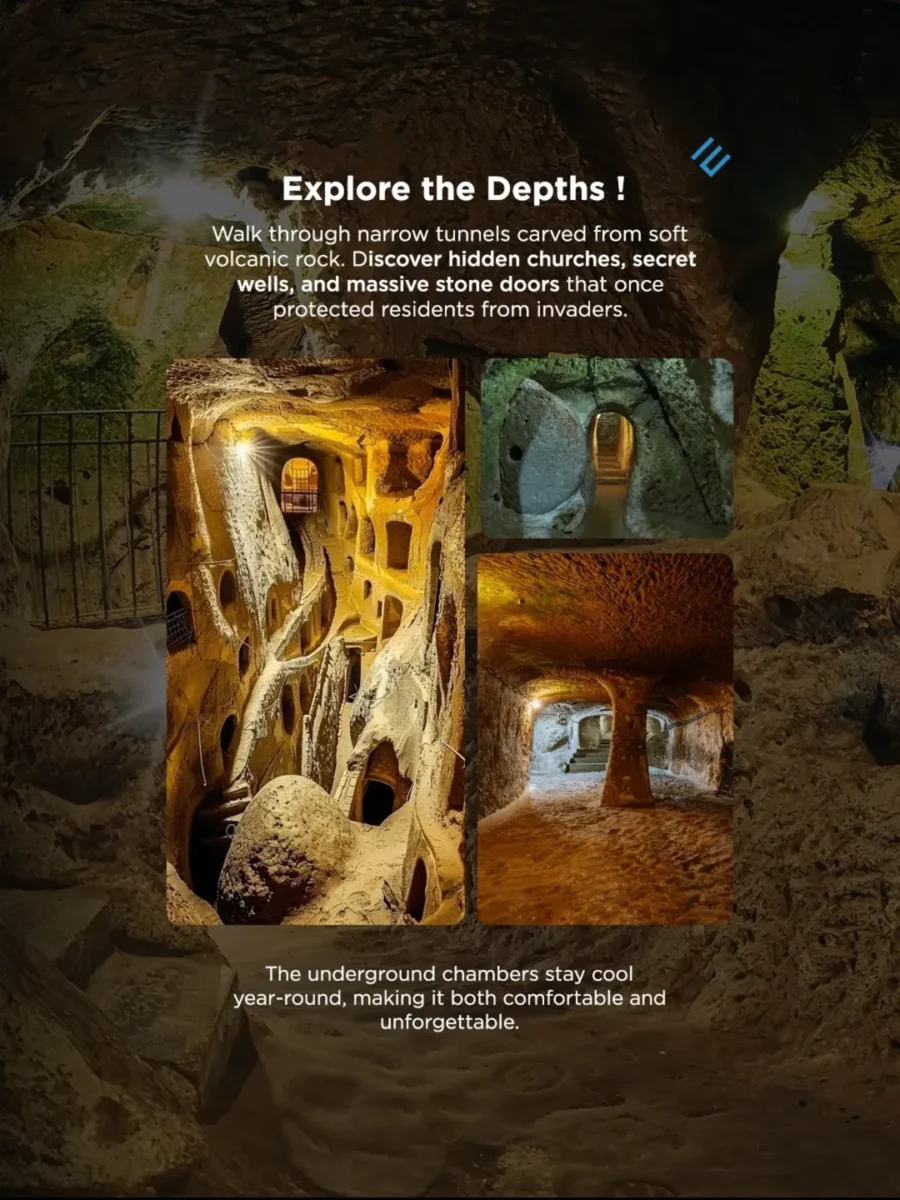
Beneath the surreal landscapes of Cappadocia, where fairy chimneys rise from volcanic valleys and hot air balloons float across the sky, lies a world few travelers truly expect. Hidden under the earth is Derinkuyu Underground City, a vast subterranean marvel that reveals humanity’s extraordinary ability to adapt, survive, and innovate.

Derinkuyu is not simply an archaeological site. It is a reminder that history is not always written on the surface. Sometimes, it is carved deep into stone—layer by layer, corridor by corridor—waiting patiently beneath our feet.

Derinkuyu
Derinkuyu
Derinkuyu

A City Carved Beneath the Earth

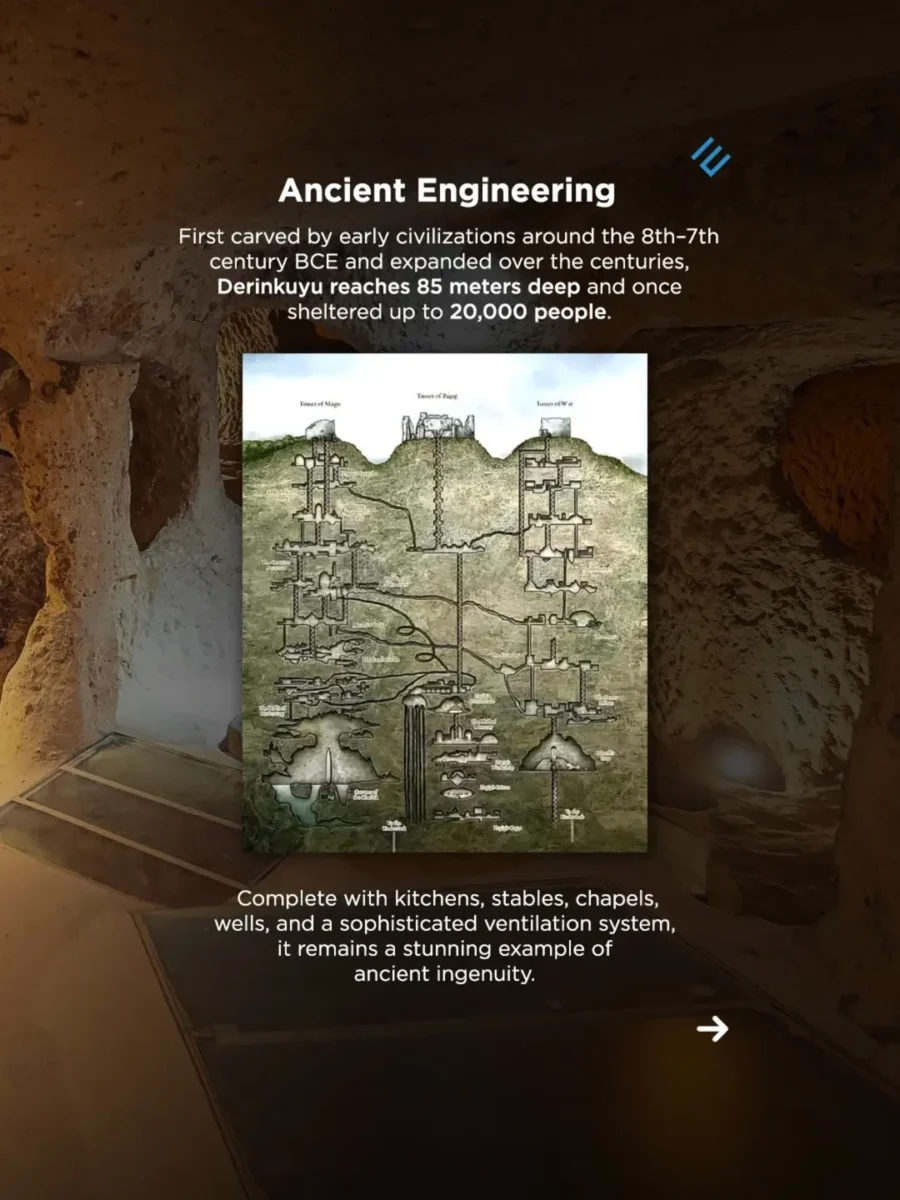
Dating back as early as the 8th–7th century BCE, Derinkuyu plunges approximately 85 meters underground, making it one of the deepest and most complex underground cities ever discovered. What began as a refuge gradually evolved into a fully functioning subterranean metropolis capable of housing up to 20,000 residents, along with their livestock and essential supplies.

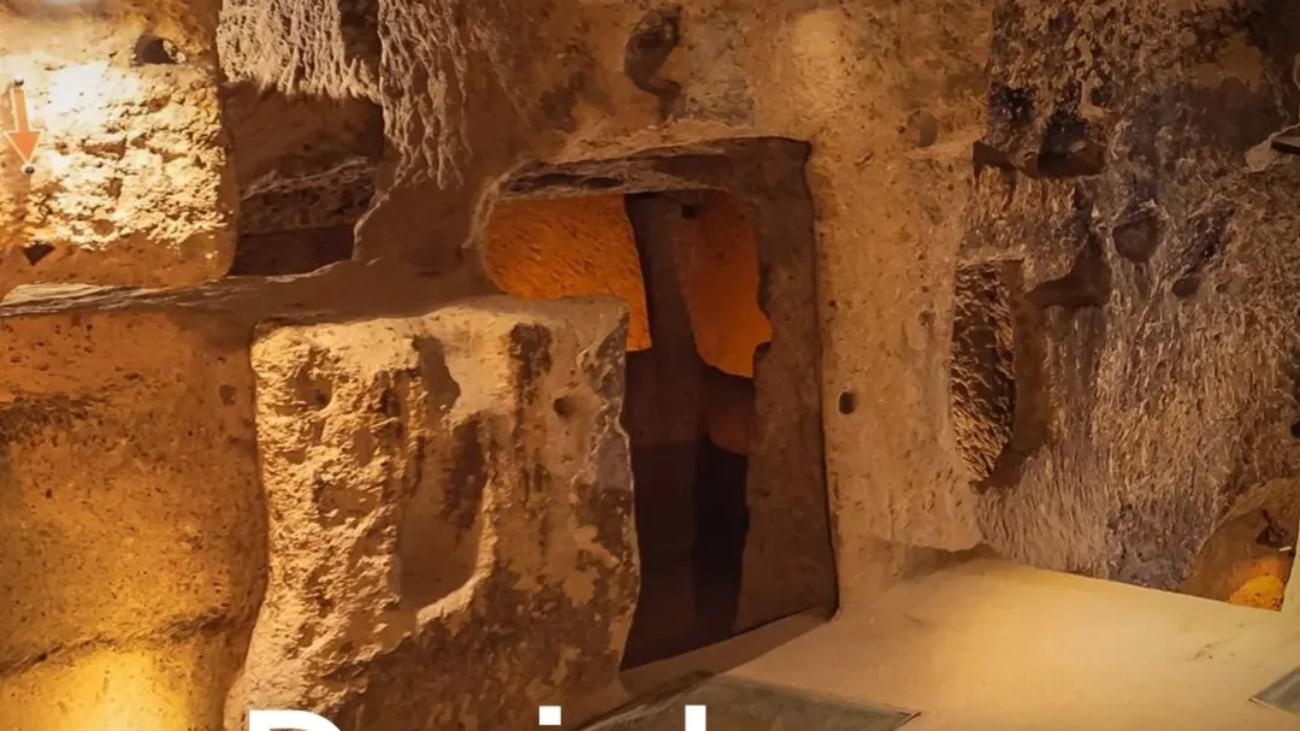
Descending into Derinkuyu feels like stepping into another dimension of history. Narrow passageways wind downward through multiple levels, each revealing carefully planned spaces designed to support life below the surface. Unlike simple caves, Derinkuyu was a city in the truest sense—engineered for long-term habitation, security, and self-sufficiency.

Ancient Engineering Ahead of Its Time

One of the most astonishing aspects of Derinkuyu is its sophisticated engineering. Despite being carved thousands of years ago using basic tools, the underground city demonstrates a deep understanding of ventilation, structure, and urban planning.

Vertical ventilation shafts stretch from the deepest levels to the surface, ensuring a constant flow of fresh air. These shafts also served as wells, providing access to clean water without exposing inhabitants to danger above ground. Massive stone doors—some weighing hundreds of kilograms—could be rolled into place to seal off sections of the city, offering protection during invasions.

The precision of this design reflects not only technical skill, but strategic foresight. Derinkuyu was built for resilience.

Life Below Ground

Walking through Derinkuyu, visitors encounter remnants of everyday life hidden beneath the earth. Stone kitchens with soot-stained ceilings reveal where meals were prepared. Storage rooms once held grains, oil, and wine, ensuring food security during extended periods underground.

There are communal spaces where residents gathered, along with stables for animals—an essential part of survival. Even more striking are the stone chapels and religious areas, reminding us that spiritual life continued even in times of uncertainty. Faith, like food and shelter, was central to the community’s resilience.

Each chamber tells a story of adaptation—how people transformed a harsh reality into a livable environment without sacrificing social structure or cultural identity.

A Refuge Through the Ages

Derinkuyu was not built for comfort alone—it was built for protection. Over centuries, the underground city served as a refuge during times of conflict, invasion, and persecution. Its hidden entrances, narrow corridors, and defensive mechanisms allowed entire communities to disappear beneath the surface when threatened.

This ability to vanish without trace is what made Derinkuyu so effective. Enemies above ground could pass by unaware that a thriving population existed below. The city stands as a testament to human ingenuity driven by necessity, fear, and hope.

The Emotional Impact of Visiting Derinkuyu

Visiting Derinkuyu today is a powerful experience. As you descend deeper into the earth, the air cools, light fades, and silence grows heavier. The space feels intimate, almost humbling. It becomes impossible not to imagine what life must have been like—families living underground, children growing up without sunlight for weeks or months, communities relying entirely on cooperation.

Rather than feeling claustrophobic, many visitors describe Derinkuyu as grounding. It offers perspective. Standing inside this underground city, you are reminded of how much humanity has endured—and how creativity often emerges in the most challenging circumstances.

Why Derinkuyu Is a Must-Visit in Turkey

Derinkuyu stands apart from typical historical attractions. It is not monumental in the traditional sense—there are no towering columns or grand façades. Instead, its greatness lies in its complexity and purpose.

Reasons Derinkuyu leaves a lasting impression:

  • One of the deepest underground cities in the world

  • Ingenious ancient engineering and urban planning

  • A rare glimpse into communal survival strategies

  • Emotional and immersive historical experience

It challenges assumptions about ancient civilizations and reshapes how we think about architecture, safety, and innovation.

Cappadocia Above and Below

What makes Derinkuyu even more remarkable is its contrast with the world above. Cappadocia is famous for its open skies, expansive valleys, and whimsical rock formations. Hot air balloons drifting at sunrise symbolize freedom and openness.

Yet just beneath this airy landscape lies a hidden world defined by enclosure and protection. Together, they create a powerful duality—above ground and below, light and shadow, freedom and refuge. Exploring both aspects offers a deeper understanding of Cappadocia’s history and soul.

Experiencing History the Right Way

A site as intricate and meaningful as Derinkuyu deserves thoughtful exploration. Understanding its history, structure, and cultural context transforms a visit from sightseeing into storytelling. Timing, pacing, and guidance all play a role in how deeply the experience resonates.

This is where careful travel planning becomes essential.

Plan Your Journey with Axcell Travel

If you are ready to journey through history and uncover one of the world’s most extraordinary hidden cities, Axcell Travel Destination is here to help. From Cappadocia’s iconic landscapes to its underground wonders, Axcell Travel curates experiences that are immersive, seamless, and unforgettable.

Whether you’re drawn by history, culture, or curiosity, your journey to Turkey can be crafted to match your interests, pace, and budget—ensuring every moment feels meaningful.

🕰️ Ready to step into a hidden world beneath Cappadocia?
📩 Contact Axcell Travel today and begin planning a journey where ancient history, human resilience, and unforgettable discovery come together.

Because some of the most powerful stories are not written in the sky—
they are carved deep within the earth.

Top Fall Escapes - Where Asia Glows in Gold

Top Fall Escapes – Where Asia Glows in Gold

Fall in Love with Asia’s Golden Season

A journey through color, calm, and timeless beauty

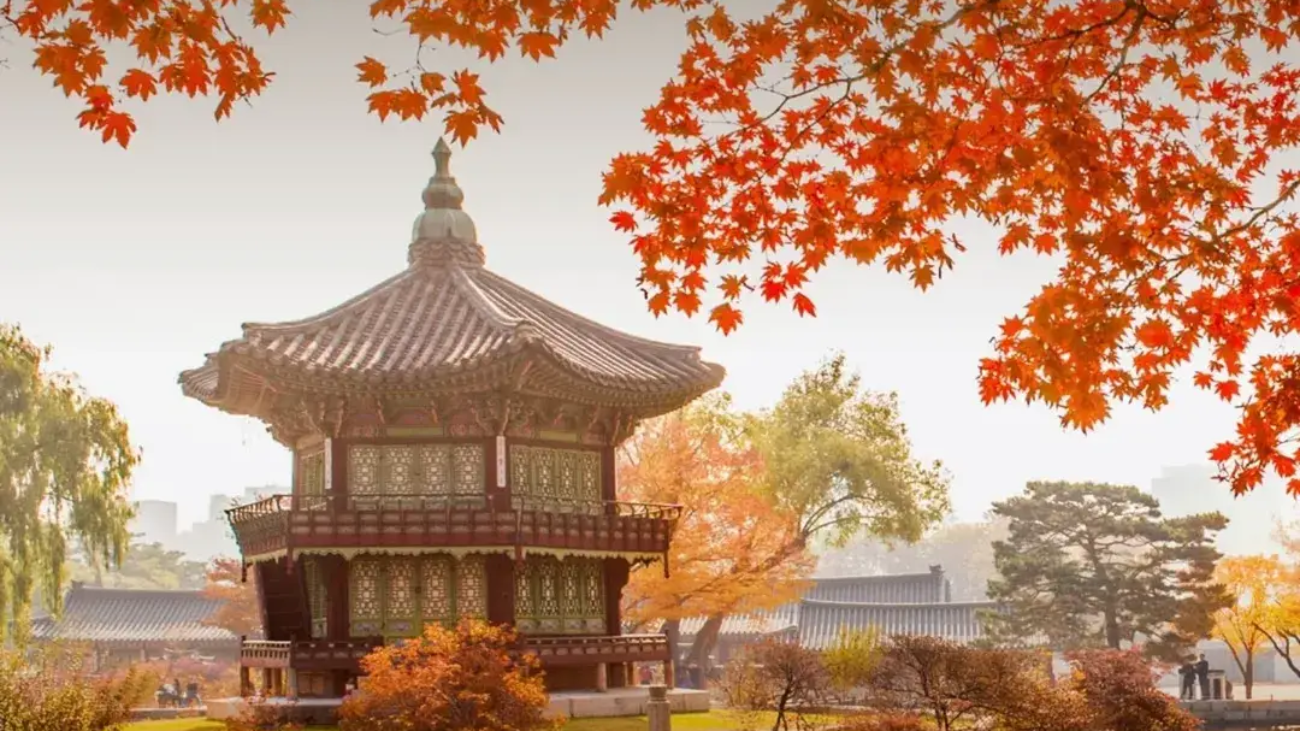
Autumn in Asia is not just a season—it is a feeling. As summer fades and the air turns crisp, landscapes across the continent are transformed by golden leaves, gentle light, and a quieter rhythm of life. From ancient temples framed by fiery maple trees to misty hills wrapped in soft autumn hues, Asia’s golden season feels like stepping into a living painting.

This is the time when travel slows, colors deepen, and every destination seems to tell its story more softly—yet more vividly. From Kyoto to Nami Island and the atmospheric streets of Jiufen, autumn in Asia is pure magic.

Top Fall Escapes - Where Asia Glows in Gold

The Magic of Autumn in Asia

What makes autumn in Asia so captivating is its balance. The heat of summer gives way to cool, comfortable days. Popular destinations feel calmer. Nature shifts into a palette of gold, crimson, and amber, creating scenes that feel both dramatic and soothing.

Unlike spring’s energetic bloom, autumn carries a sense of reflection. It is a season of pause—of appreciating beauty without urgency. Travelers find themselves lingering longer at viewpoints, walking slower through historic streets, and savoring moments rather than rushing through itineraries.

Autumn is when Asia feels most poetic.

Kyoto - Temples Wrapped in Fire and Gold

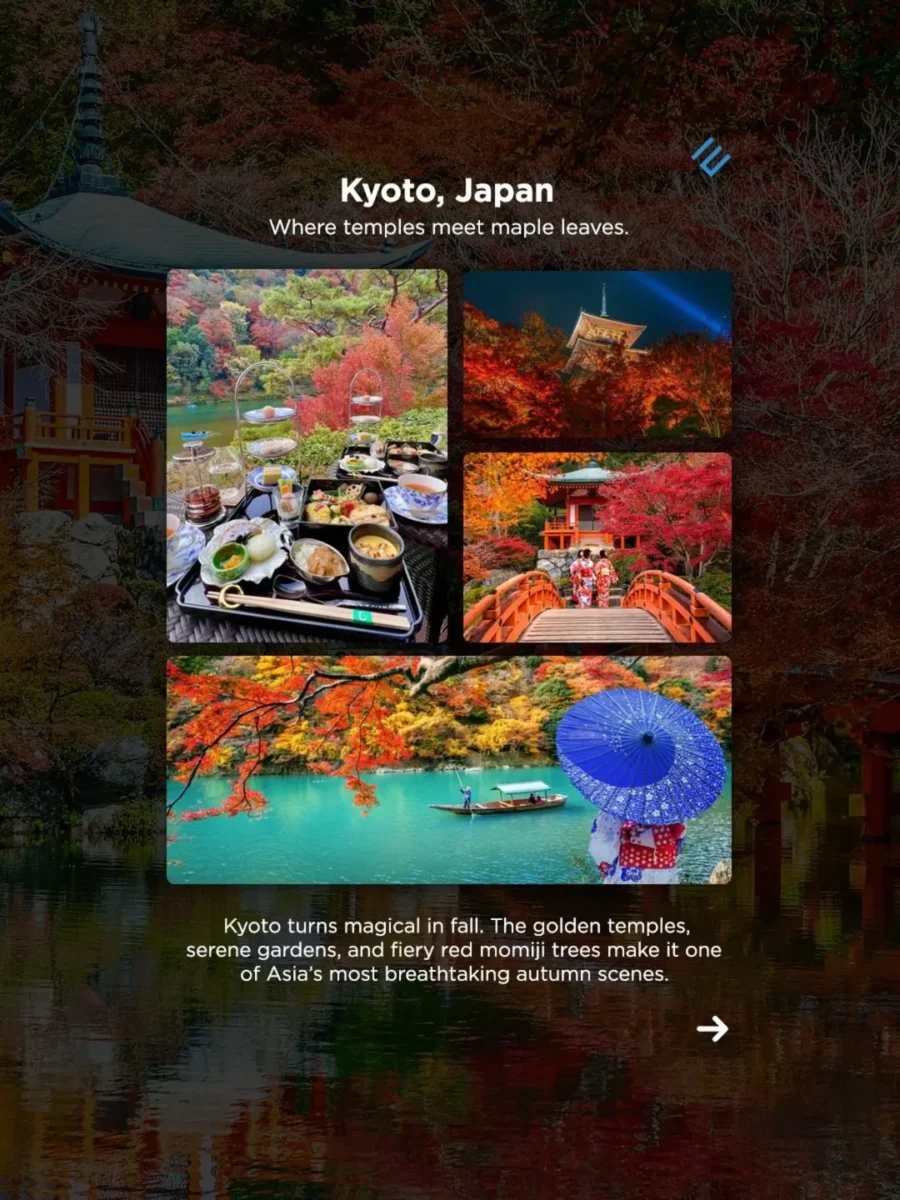
In Japan, autumn reaches its most iconic expression in Kyoto. As the former imperial capital, Kyoto is already rich in history and spirituality. During fall, its temples and gardens become breathtaking works of art.

Maple trees turn brilliant shades of red and orange, framing wooden temples, stone pathways, and tranquil ponds. Visiting Kyoto in autumn feels like walking through centuries of tradition enhanced by nature’s most dramatic colors. The contrast between ancient architecture and glowing foliage creates scenes that are both powerful and serene.

Quiet temple grounds, soft footsteps on fallen leaves, and the faint scent of incense add to the atmosphere. Kyoto in autumn is not about spectacle—it is about harmony.

Nami Island - A Golden Corridor of Calm

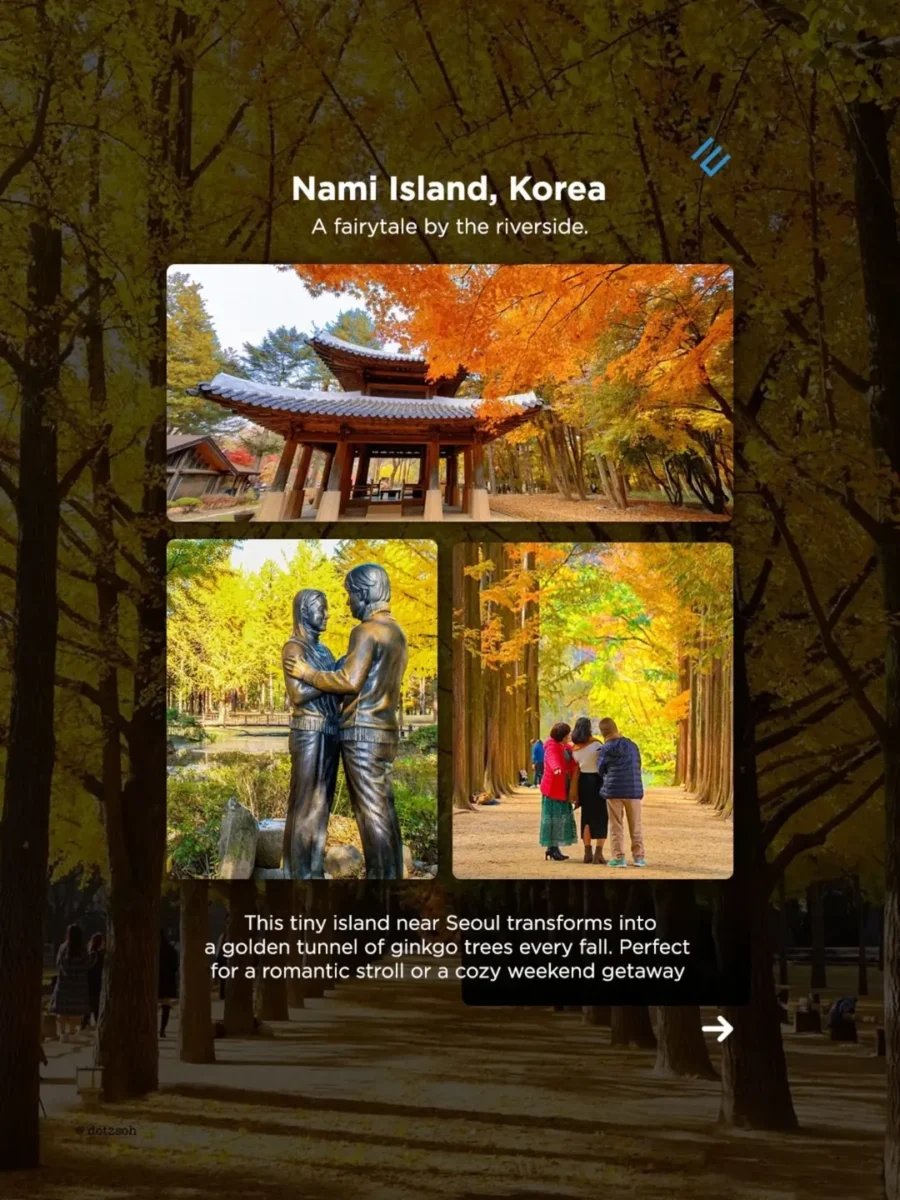
Moving to South Korea, autumn takes on a gentle, romantic tone at Nami Island. Famous for its tree-lined paths, the island becomes especially enchanting when ginkgo trees turn bright yellow, forming glowing tunnels of light.

Walking through Nami Island during fall feels peaceful and intimate. Leaves crunch softly underfoot, cool air carries the scent of earth and water, and the island’s natural beauty encourages unhurried exploration. It is a place where travelers come to slow down—to stroll, to photograph, to simply be present.

Nami Island captures the emotional side of autumn: calm, nostalgia, and quiet joy.

Jiufen - Mist, Mountains, and Autumn Atmosphere

In Taiwan, autumn reveals itself through atmosphere rather than foliage alone. Jiufen, a historic mountain town overlooking the sea, becomes especially magical during the fall season.

As temperatures cool, mist rolls gently over the hills, wrapping the town in a soft, dreamlike haze. Lantern-lit streets glow warmly against the gray skies, while tea houses offer cozy spaces to watch the fog drift through the valleys. Autumn in Jiufen feels cinematic—moody, romantic, and deeply atmospheric.

Rather than bold colors, Jiufen’s fall beauty lies in subtlety: shifting light, quiet streets, and moments of stillness that invite reflection.

A Season Made for Thoughtful Travel

Autumn is often considered the ideal travel season in Asia. Weather conditions are comfortable, landscapes are visually stunning, and destinations feel less crowded than during peak summer months. This creates space for deeper experiences—more meaningful interactions, more time to absorb culture, and more opportunities to connect with place.

Whether exploring historic cities, nature-filled islands, or misty mountain towns, autumn encourages travelers to engage with destinations on a more personal level. It is a season that rewards curiosity and patience.

Autumn Colors, Cultural Depth

Beyond natural beauty, autumn in Asia is deeply connected to culture and tradition. Seasonal festivals, harvest celebrations, and local cuisine reflect the rhythms of the land. Warm teas, comforting dishes, and seasonal flavors become part of the travel experience.

In many Asian cultures, autumn symbolizes gratitude, balance, and reflection. Traveling during this season allows visitors to witness how nature and culture intertwine—how landscapes influence rituals, and how seasons shape daily life.

Why Asia’s Golden Season Feels So Special

Autumn travel in Asia offers something rare in today’s fast-paced world: calm. The season invites travelers to slow down, to wander without pressure, and to appreciate beauty in its quieter form.

Highlights of traveling Asia in autumn include:

  • Comfortable temperatures and crisp air

  • Rich autumn foliage and atmospheric landscapes

  • Fewer crowds and a more relaxed pace

  • Deeper cultural immersion and seasonal experiences

It is a season for travelers who value feeling over rushing.

Crafting a Journey That Feels Personal

Experiencing Asia’s golden season is about more than choosing destinations—it is about timing, balance, and intention. A thoughtfully designed itinerary allows you to enjoy each place at its best, without feeling overwhelmed or constrained.

This is where expert planning transforms a trip into a story.

With Axcell Travel Destination, your autumn journey through Asia is crafted to reflect your style, interests, and budget. Whether you seek cultural depth, scenic beauty, romantic escapes, or a blend of everything, each detail is designed to feel seamless and meaningful.

From selecting the right travel window to balancing iconic sights with quiet moments, Axcell Travel Destination ensures your journey feels personal—never generic.

A Season Worth Remembering

Autumn in Asia is not just something you see—it is something you carry with you. Long after the leaves have fallen, memories remain: temple silhouettes against red maples, golden ginkgo paths beneath open skies, lanterns glowing through misty hills.

These are the moments that define travel—not checklists, but emotions.

Let us craft your fall escape, tailored to your style and budget.
Experience the charm, colors, and calm of Asia’s golden season—where every journey feels like a story worth telling.

Fall under Venice’s spell.

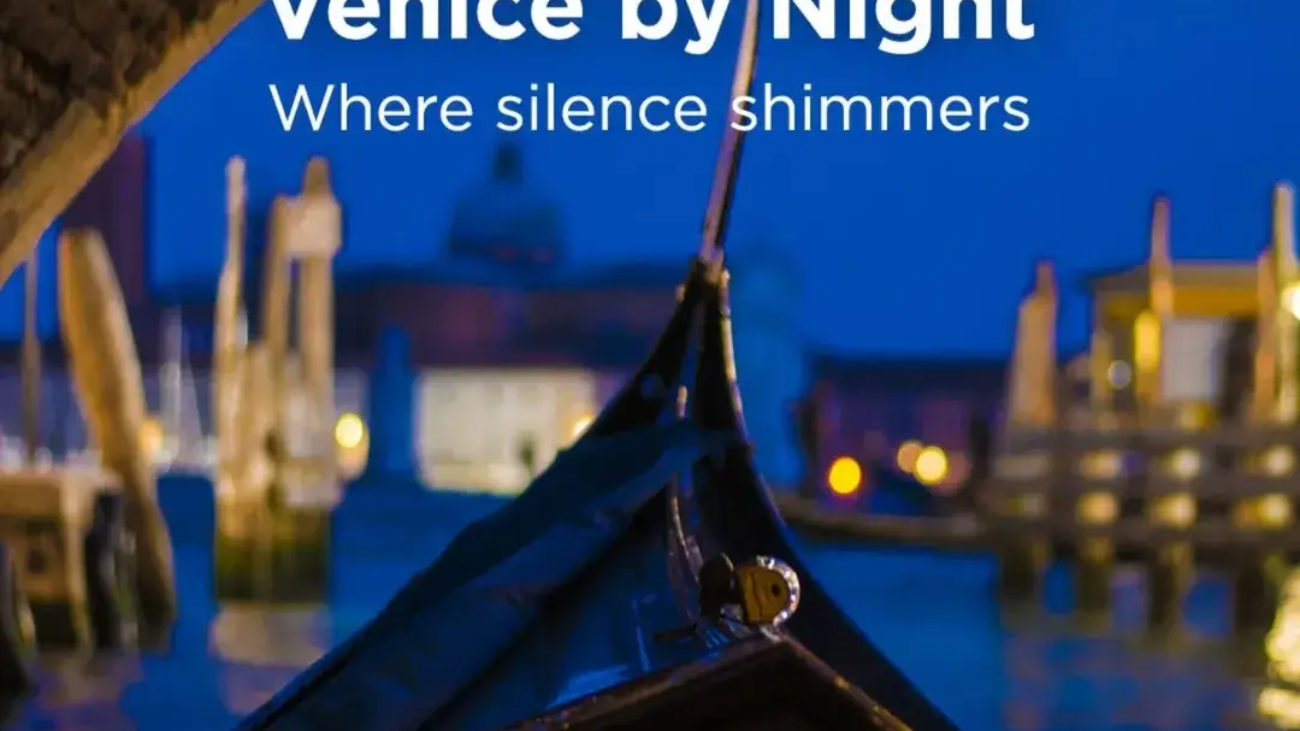
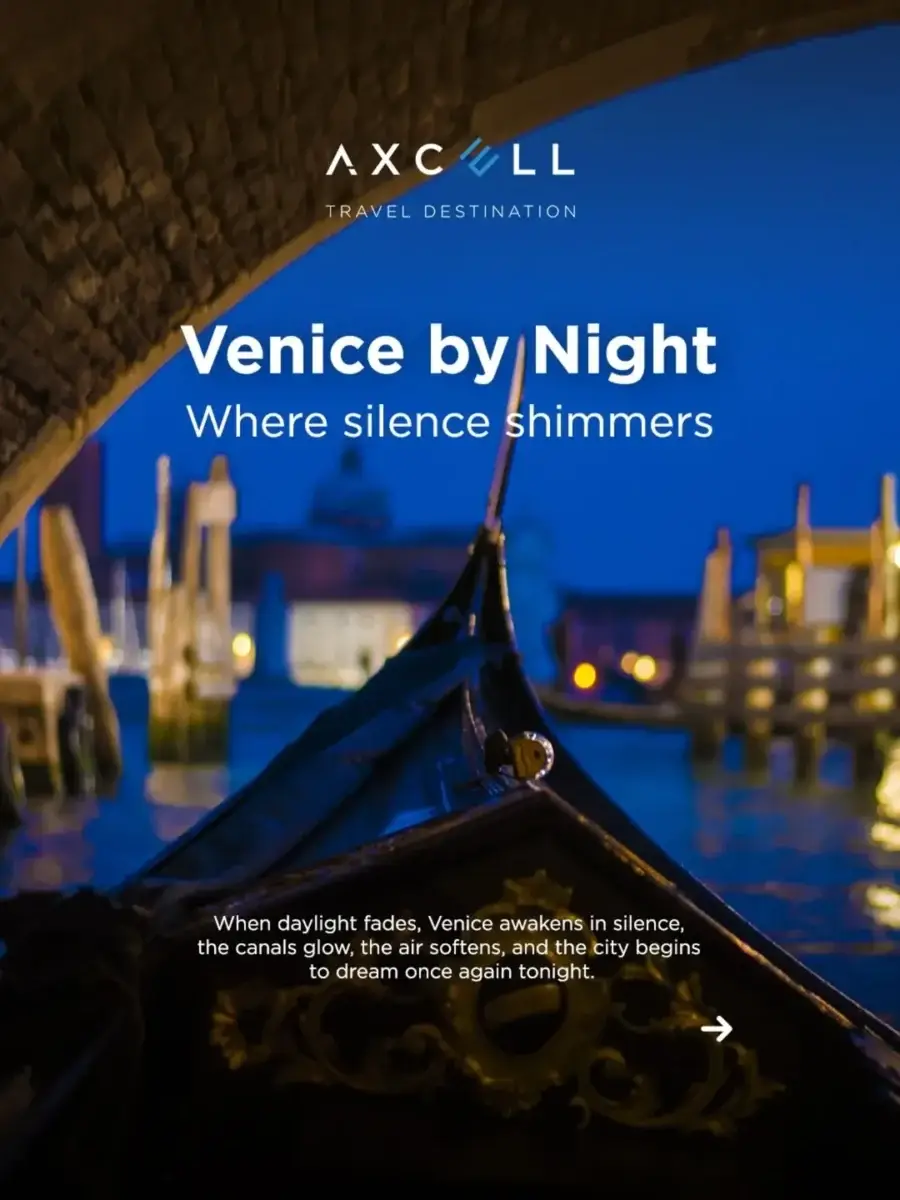
Venice by Night – Where Silent

Fall Under Venice’s Spell: A Midnight Romance Written on Water

There are destinations that impress you at first sight, and then there are places that slowly, quietly cast a spell.
Venice belongs to the latter.

By daylight, Venice dazzles with its architecture, history, and movement. Gondolas weave through busy canals, footsteps echo across bridges, and the city hums with visitors discovering its beauty. Yet when the sun begins to fade and the crowds drift away, Venice reveals its truest self. The city softens. The canals shimmer like glass. Golden lights reflect on ancient walls. And suddenly, Venice feels less like a destination—and more like a feeling.

This is Venice at night.
This is where romance lives.

Fall under Venice’s spell.

When the City Slows, the Magic Begins

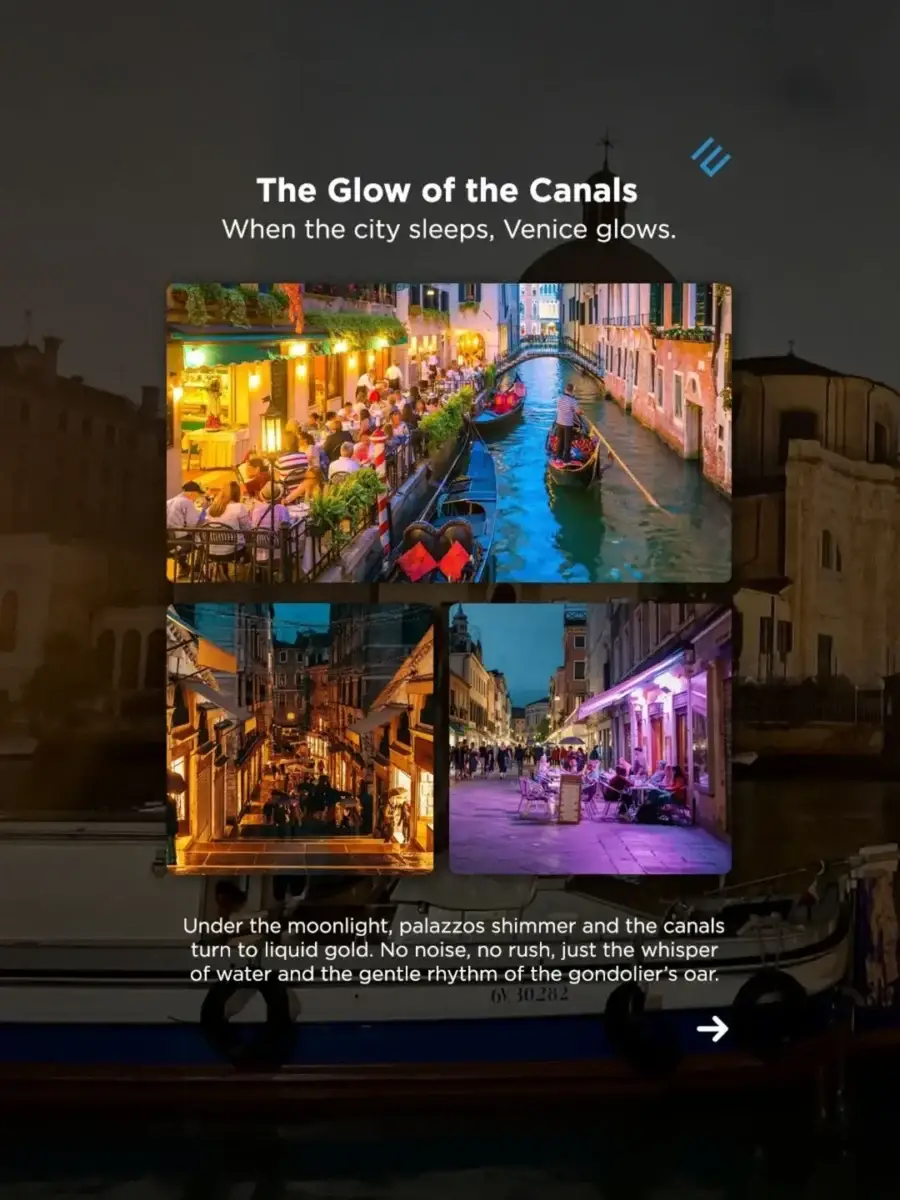
As evening settles in, Venice transforms with remarkable grace. Streets grow quieter, conversations soften, and the rhythm of the city slows to a gentle pulse. Lanterns flicker to life along canals and alleyways, casting warm reflections that dance on the water. The absence of noise allows details to emerge—the sound of water brushing stone, distant music floating through open windows, the echo of footsteps crossing a bridge.

Venice does not rush you after dark. Instead, it invites you to linger. To walk without purpose. To pause simply because the moment feels right. In this stillness, the city becomes intimate, revealing why it has inspired poets, artists, and lovers for centuries.

Midnight Gondolas - Romance in Motion

Few experiences in the world are as evocative as a gondola ride at night. When the canals empty and the city quiets, gondolas glide through narrow waterways illuminated by moonlight and soft lamps. The reflections feel endless—bridges, balconies, lanterns, and sky merging into one fluid dream.

A midnight gondola ride is not about sightseeing. It is about emotion. About sharing silence, exchanging glances, and letting the city move around you. The gentle rhythm of the water and the slow pace of the ride create a sense of timelessness, as if the outside world has faded away.

In these moments, Venice feels personal—like it exists just for you.

Moonlit Bridges and Whispered Promises

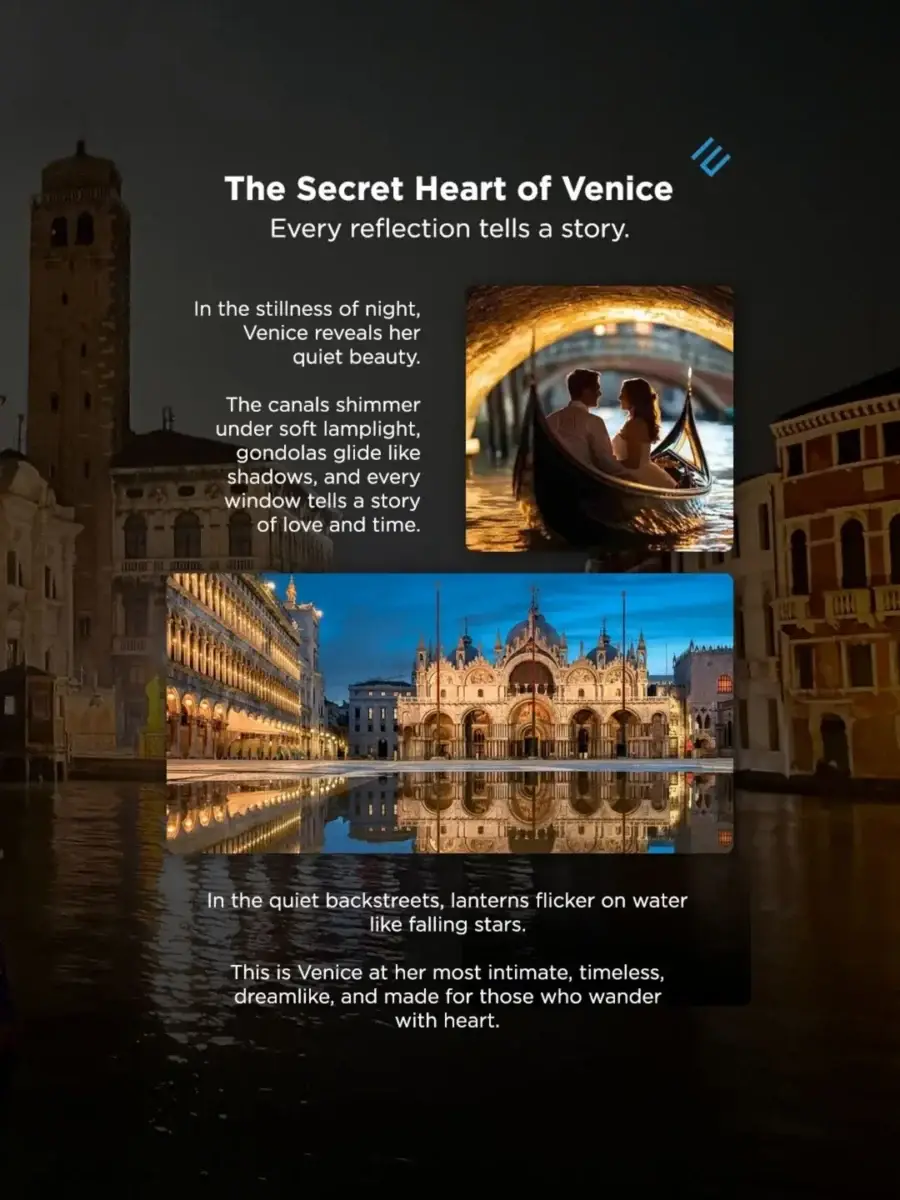
Venice’s bridges take on a different character at night. By day, they are busy crossings. After dark, they become quiet stages for reflection. Under the moon’s glow, their arches frame still canals and shimmering lights, creating scenes that feel lifted from a classic film.

Couples pause halfway across, leaning on cool stone railings, watching the city reflect itself below. There is something profoundly romantic about these pauses—moments without words, without plans, simply shared presence. Every bridge seems to hold memories of past lovers, whispered promises, and stories written quietly over time.

The Soft Music of the Night

Venice after sunset has its own soundtrack. It is not loud or dramatic, but subtle and atmospheric. Live music drifts gently from tucked-away restaurants. Glasses clink softly in candlelit cafés. Somewhere nearby, a violin hums beneath open windows.

Rather than nightlife filled with noise, Venice offers ambience. Nights are meant for conversation, connection, and stillness. Sitting beside a canal with a glass of wine, watching reflections ripple across the water, feels infinitely richer than any planned entertainment.

This is a city that understands romance is not about spectacle—but about mood.

A City Made for Lovers and Dreamers

Venice has always been a place of passion and poetry. Built on water, shaped by centuries of trade, art, and cultural exchange, it carries an emotional depth few cities possess. Writers have fallen in love with its decay, filmmakers with its light, and travelers with the way it makes them feel.

At night, this emotional weight becomes tangible. You sense history not as something distant, but as something alive—embedded in walls, bridges, and canals. Walking through Venice after dark feels like moving through layers of time, where past and present exist side by side.

Venice reminds you that romance does not need perfection. Its beauty lies in imperfection, in fading paint, uneven stones, and reflections that are never quite still.

A Cinematic Experience, Frame by Frame

Everything about Venice at night feels cinematic. The lighting, the silence, the slow movement—it all feels designed for storytelling. Even a simple walk becomes a scene: shadows stretching across walls, footsteps echoing down narrow streets, lanterns glowing like punctuation marks in the dark.

This is why Venice leaves such a lasting impression. You don’t just remember what you saw—you remember how it felt. The city becomes part of your story, framing memories that feel vivid long after you leave.

Why Venice After Dark Is Truly Special

Experiencing Venice at night offers something daytime never can:

  • Fewer crowds and deeper intimacy

  • A slower pace that invites connection

  • Romantic gondola rides beneath moonlight

  • Quiet bridges and candlelit canals

  • A city that feels emotional, not performative

For couples, Venice after dark becomes a shared memory—one defined not by landmarks, but by moments.

Designed with Intention, Experienced with Emotion

To experience Venice at its most magical, timing and planning matter. Knowing when to wander, where to stay, and how to move through the city can transform a trip from ordinary to unforgettable. Venice rewards those who approach it thoughtfully.

This is where curated travel makes all the difference.

With Axcell Travel Destination, your romantic escape to Venice is crafted with care and emotion. From atmospheric accommodations to moonlit gondola experiences and quiet routes away from crowds, every detail is designed to support intimacy and discovery.

Whether you are celebrating love, marking a milestone, or simply seeking a cinematic journey, your Venice story deserves to feel personal.

Venice Leaves a Mark on the Heart

When you leave Venice, you don’t just take photographs. You carry sensations—the glow of lanterns on water, the hush of midnight canals, the warmth of walking beside someone you love through streets shaped by centuries of romance.

Venice doesn’t shout its beauty.
It whispers it—slowly, softly, and forever.

Let us design your romantic escape to Venice—timeless, cinematic, and made just for you.
Because in Venice, every reflection tells a love story…
and yours is waiting to be written. 

Strasbourg – Where Christmas becomes a city – EL#1

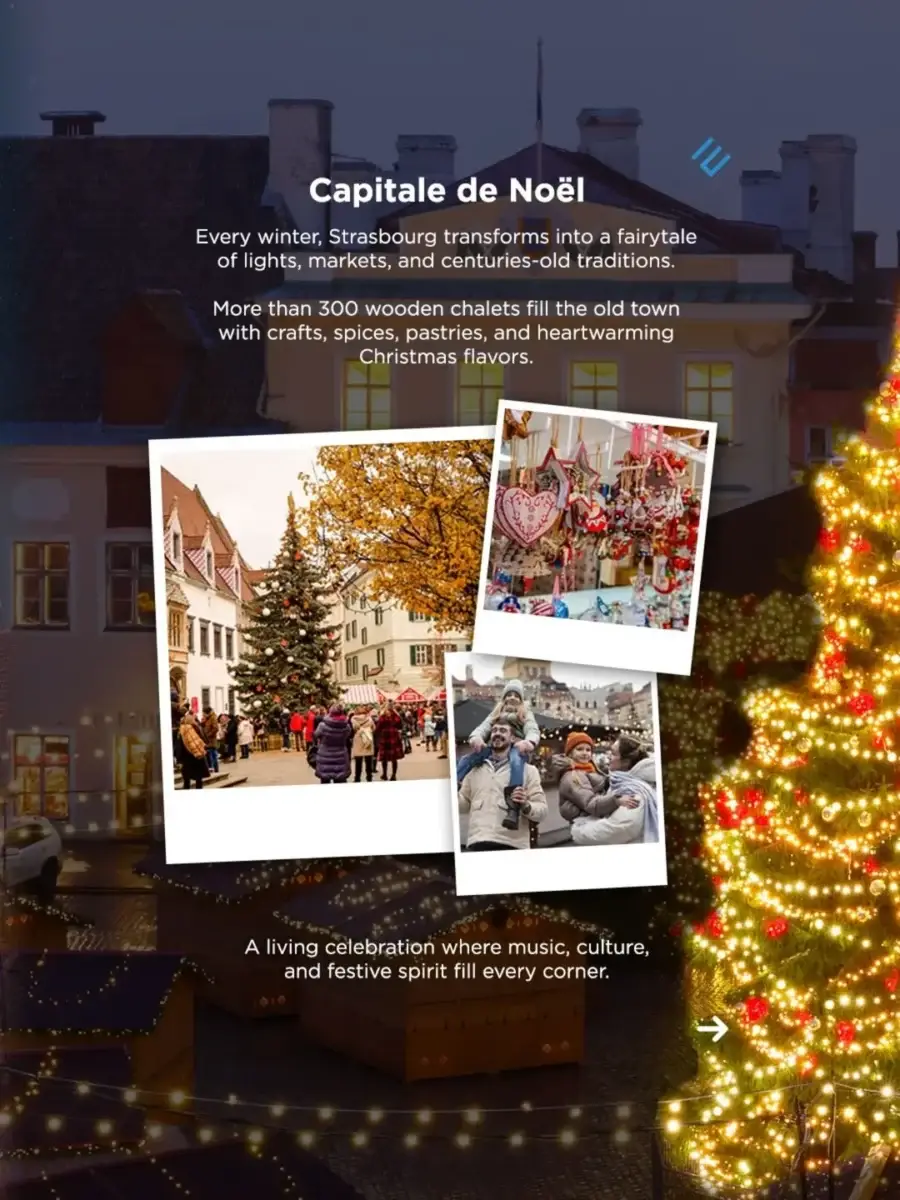
In December, Strasbourg is no longer just a destination on the map—it becomes Christmas in its purest form. As winter settles over the Alsace region, the city transforms into a glowing storybook, where history, tradition, and festive magic come together in a way few places in Europe can rival.

From the moment you arrive, Strasbourg feels different. The air carries the scent of spices and warm wine, streets shimmer with thousands of lights, and half-timbered houses seem to glow under festive decorations. This is not a city that merely celebrates Christmas—it lives and breathes it.

A City Transformed into a Winter Wonderland

Strasbourg’s historic old town, Grande Île, becomes the heart of the festivities. Cobblestone streets wind between canals and medieval buildings, each adorned with garlands, stars, and twinkling lights. Shop windows turn into festive displays, balconies overflow with greenery, and even the smallest alley feels carefully dressed for the season.

Unlike many cities where Christmas markets feel contained to a single square, Strasbourg’s celebrations spread throughout the city. With over 300 wooden chalets scattered across multiple locations, wandering the streets feels like moving through chapters of a winter fairytale. Every turn reveals something new—music drifting through the air, laughter from cafés, and the glow of lanterns reflecting on the water.

Christkindelsmärik: One of Europe’s Oldest Christmas Markets

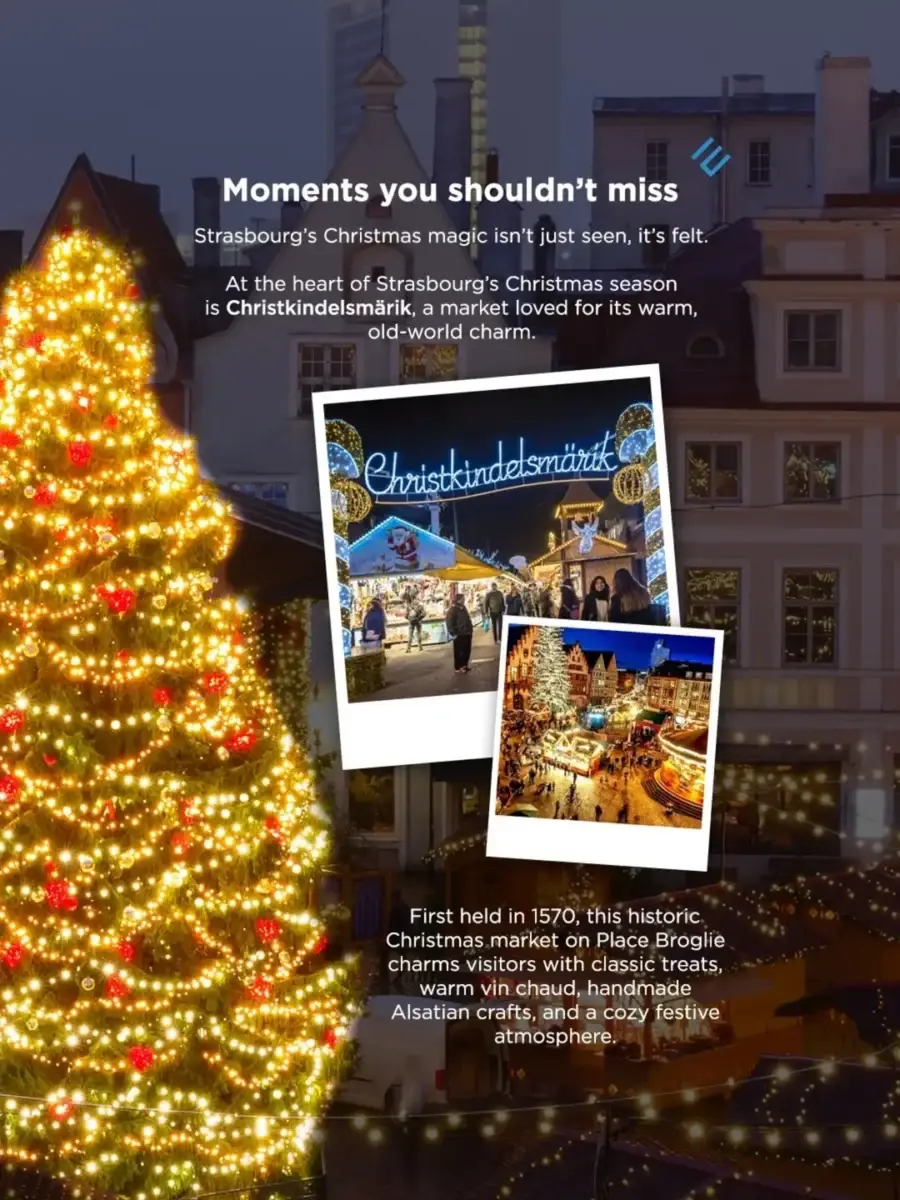
At the heart of Strasbourg’s Christmas identity lies Christkindelsmärik, one of the oldest Christmas markets in Europe, dating back to 1570. This centuries-old tradition is not just a seasonal attraction; it is a living piece of history that continues to shape the city’s character.

Located around Place Broglie and surrounding squares, Christkindelsmärik offers a deeply authentic Christmas experience. Wooden stalls overflow with handcrafted Alsatian gifts, delicate ornaments, wooden toys, and festive decorations that reflect generations of local craftsmanship. Every item tells a story—of tradition passed down, of artisans preserving techniques, and of a culture that values warmth and togetherness.

Flavors That Define the Season

Christmas in Strasbourg is as much about taste as it is about sight. The markets are filled with seasonal flavors that instantly warm the body and spirit. A cup of vin chaud—mulled wine infused with spices and citrus—is almost essential, especially as temperatures drop in the evening.

Local specialties such as bredele (traditional Alsatian Christmas cookies), roasted chestnuts, gingerbread, and savory treats fill the air with irresistible aromas. Enjoying these flavors while standing beneath glowing lights, surrounded by historic architecture, creates moments that feel both comforting and magical

Strasbourg Cathedral: A Festive Landmark

Towering above the city, Strasbourg Cathedral becomes even more breathtaking during December. Its intricate Gothic façade is illuminated against the winter sky, serving as both a visual and emotional centerpiece of the city’s celebrations.

Nearby Christmas markets and festive installations add to the atmosphere, making the cathedral not just a landmark, but a gathering point. Standing in its shadow, surrounded by lights and music, it’s easy to feel the weight of history blending seamlessly with modern celebration.

Lorem ipsum dolor sit amet, consectetur adipiscing elit. Ut elit tellus, luctus nec ullamcorper mattis, pulvinar dapibus leo.

A Celebration Rooted in Tradition

What makes Strasbourg truly special is its authenticity. Christmas here is not a trend or a performance—it is a deeply rooted tradition shaped by Alsatian culture, which blends French and German influences. This unique heritage is reflected in the decorations, the music, the food, and the overall atmosphere.

Locals participate wholeheartedly, decorating homes, attending markets, and embracing the season with pride. Visitors are not treated as outsiders, but welcomed into a shared celebration that values warmth, generosity, and togetherness.

A Slower, More Meaningful Year-End Escape

Strasbourg in December invites travelers to slow down. Rather than rushing between attractions, the city encourages wandering—lingering at a stall, sipping something warm by the canal, or simply watching lights reflect on medieval façades.

This slower pace makes Strasbourg an ideal year-end escape. It offers a chance to step away from routine, reconnect with simple joys, and experience a festive season that feels sincere rather than commercial.

Why Strasbourg Is the Perfect Christmas Destination

For those dreaming of a magical holiday journey, Strasbourg offers everything Christmas lovers seek:

  • One of Europe’s oldest and most authentic Christmas markets
  • A beautifully preserved old town transformed by festive décor
  • Rich culinary traditions unique to the Alsace region
  • A warm, storybook atmosphere that feels timeless

Few places manage to combine history, culture, and festive spirit so seamlessly.

Begin Your Christmas Story Here

If you’re dreaming of a destination where December feels truly special—where every street glows and every moment feels meaningful—Strasbourg might just be the perfect place to begin. It is not only a city to visit, but a feeling to experience.

Because in Strasbourg, Christmas isn’t just a season.
It’s a story—one you get to step inside.

6.1

Strasbourg – Where Christmas becomes a city

Strasbourg in December – When the City Becomes Christmas Itself

In December, Strasbourg is no longer just a destination on the map—it becomes Christmas in its purest form. As winter settles over the Alsace region, the city transforms into a glowing storybook, where history, tradition, and festive magic come together in a way few places in Europe can rival.

From the moment you arrive, Strasbourg feels different. The air carries the scent of spices and warm wine, streets shimmer with thousands of lights, and half-timbered houses seem to glow under festive decorations. This is not a city that merely celebrates Christmas—it lives and breathes it.

A City Transformed into a Winter Wonderland

Strasbourg’s historic old town, Grande Île, becomes the heart of the festivities. Cobblestone streets wind between canals and medieval buildings, each adorned with garlands, stars, and twinkling lights. Shop windows turn into festive displays, balconies overflow with greenery, and even the smallest alley feels carefully dressed for the season.

Unlike many cities where Christmas markets feel contained to a single square, Strasbourg’s celebrations spread throughout the city. With over 300 wooden chalets scattered across multiple locations, wandering the streets feels like moving through chapters of a winter fairytale. Every turn reveals something new—music drifting through the air, laughter from cafés, and the glow of lanterns reflecting on the water.

Christkindelsmärik: One of Europe’s Oldest Christmas Markets

At the heart of Strasbourg’s Christmas identity lies Christkindelsmärik, one of the oldest Christmas markets in Europe, dating back to 1570. This centuries-old tradition is not just a seasonal attraction; it is a living piece of history that continues to shape the city’s character.

Located around Place Broglie and surrounding squares, Christkindelsmärik offers a deeply authentic Christmas experience. Wooden stalls overflow with handcrafted Alsatian gifts, delicate ornaments, wooden toys, and festive decorations that reflect generations of local craftsmanship. Every item tells a story—of tradition passed down, of artisans preserving techniques, and of a culture that values warmth and togetherness.


Flavors That Define the Season

Christmas in Strasbourg is as much about taste as it is about sight. The markets are filled with seasonal flavors that instantly warm the body and spirit. A cup of vin chaud—mulled wine infused with spices and citrus—is almost essential, especially as temperatures drop in the evening.

Local specialties such as bredele (traditional Alsatian Christmas cookies), roasted chestnuts, gingerbread, and savory treats fill the air with irresistible aromas. Enjoying these flavors while standing beneath glowing lights, surrounded by historic architecture, creates moments that feel both comforting and magical.

Strasbourg Cathedral: A Festive Landmark

Towering above the city, Strasbourg Cathedral becomes even more breathtaking during December. Its intricate Gothic façade is illuminated against the winter sky, serving as both a visual and emotional centerpiece of the city’s celebrations.

Nearby Christmas markets and festive installations add to the atmosphere, making the cathedral not just a landmark, but a gathering point. Standing in its shadow, surrounded by lights and music, it’s easy to feel the weight of history blending seamlessly with modern celebration.

A Celebration Rooted in Tradition

What makes Strasbourg truly special is its authenticity. Christmas here is not a trend or a performance—it is a deeply rooted tradition shaped by Alsatian culture, which blends French and German influences. This unique heritage is reflected in the decorations, the music, the food, and the overall atmosphere.

Locals participate wholeheartedly, decorating homes, attending markets, and embracing the season with pride. Visitors are not treated as outsiders, but welcomed into a shared celebration that values warmth, generosity, and togetherness.

A Slower, More Meaningful Year-End Escape

Strasbourg in December invites travelers to slow down. Rather than rushing between attractions, the city encourages wandering—lingering at a stall, sipping something warm by the canal, or simply watching lights reflect on medieval façades.

This slower pace makes Strasbourg an ideal year-end escape. It offers a chance to step away from routine, reconnect with simple joys, and experience a festive season that feels sincere rather than commercial.

Why Strasbourg Is the Perfect Christmas Destination

For those dreaming of a magical holiday journey, Strasbourg offers everything Christmas lovers seek:

  • One of Europe’s oldest and most authentic Christmas markets
  • A beautifully preserved old town transformed by festive décor
  • Rich culinary traditions unique to the Alsace region
  • A warm, storybook atmosphere that feels timeless

Few places manage to combine history, culture, and festive spirit so seamlessly.

Begin Your Christmas Story Here

If you’re dreaming of a destination where December feels truly special—where every street glows and every moment feels meaningful—Strasbourg might just be the perfect place to begin. It is not only a city to visit, but a feeling to experience.

Because in Strasbourg, Christmas isn’t just a season.
It’s a story—one you get to step inside.

5.1

Zhongshuge Bookstore – Where books feel like art

Zhongshuge (钟书阁) – When a Bookstore Becomes a Cultural Landmark

At first glance, Zhongshuge may appear to be just another bookstore. But the moment you step inside, it becomes clear that Zhongshuge is something far greater. It is a space where architecture, literature, and local identity come together—transforming reading into an immersive cultural experience.

Across China, Zhongshuge has earned a reputation not merely as a place to buy books, but as a destination in its own right. Each branch feels like a living gallery, designed to reflect the spirit of the city it inhabits while celebrating the timeless power of books.

A Bookstore Designed as an Experience

What truly sets Zhongshuge apart is its striking architectural vision. Far from traditional bookstore layouts, Zhongshuge spaces are known for dramatic mirrors, soaring shelves, curved corridors, and optical illusions that make the space feel infinite. Walking inside often feels like stepping into a dreamlike library where reality and imagination blur.

The design is intentional. Every corridor invites curiosity, every reflection encourages exploration. Books are not simply arranged on shelves; they are integrated into the architecture, becoming part of the visual storytelling. In Zhongshuge, reading begins long before you open a book—it starts the moment you enter the space.

Each City, a Different Story

One of the most fascinating aspects of Zhongshuge is that no two branches are the same. Each location is thoughtfully designed to draw inspiration from its surrounding city—its history, culture, and identity.

In Shanghai, Zhongshuge reflects the city’s cosmopolitan energy, blending modern design with intellectual sophistication. In Chongqing, the bookstore mirrors the city’s layered urban landscape, featuring dramatic staircases and complex spatial layouts that echo Chongqing’s hills and bridges. Meanwhile, branches in Hangzhou incorporate softer, more poetic elements inspired by traditional Chinese aesthetics and the city’s literary heritage.

This localized design philosophy turns each visit into a unique cultural encounter. Travelers who explore multiple Zhongshuge branches across China often describe it as collecting chapters of a story—each bookstore revealing a different narrative shaped by its environment.

Curated Collections That Reflect Culture

Beyond its architecture, Zhongshuge is deeply committed to the content it offers. The bookstore’s collections are carefully curated to balance Chinese literature, global titles, art books, philosophy, history, and contemporary thought. It is a place where readers can discover both classic works and emerging voices.

For international visitors, Zhongshuge offers a rare opportunity to engage with Chinese culture through literature. Browsing its shelves provides insight into the country’s intellectual landscape—what stories are being told, what ideas are shaping modern China, and how tradition and innovation coexist.

Even for those who may not read Chinese fluently, the visual appeal of art books, photography collections, and design publications makes the experience rewarding. Zhongshuge understands that books communicate not only through words, but also through form, imagery, and atmosphere.

A Space to Slow Down

In fast-paced cities filled with noise and movement, Zhongshuge offers something increasingly rare: a place to slow down. The carefully designed seating areas, quiet corners, and warm lighting invite visitors to linger. It is common to see people sitting quietly, reading, reflecting, or simply admiring the space.

This emphasis on calm and contemplation aligns with Zhongshuge’s deeper philosophy—that reading is not just an activity, but a state of mind. The bookstore encourages visitors to pause, disconnect from distractions, and reconnect with curiosity and imagination.

More Than a Bookstore

Over time, Zhongshuge has become a cultural landmark and a symbol of modern Chinese creativity. It represents a shift in how public spaces can function—not just as commercial venues, but as places of inspiration and cultural exchange.

For travelers, visiting Zhongshuge often becomes one of the most memorable parts of a China journey. It offers a glimpse into how contemporary China values knowledge, design, and storytelling. In a country known for its ancient history and rapid modernization, Zhongshuge stands at the intersection of both—honoring the past while embracing the future.

Zhongshuge as a Travel Destination

Today, many travelers intentionally include Zhongshuge in their itineraries, much like museums or architectural landmarks. It is photographed, shared, and remembered—not because it is trendy, but because it leaves an emotional impression.

Whether you are browsing art books, discovering Chinese literature, or simply admiring the architecture, Zhongshuge turns a simple bookstore visit into a meaningful travel experience. It proves that cultural discovery does not always require grand monuments; sometimes, it happens quietly among shelves of books.

Thoughtful Travel Makes the Difference

Experiences like Zhongshuge are best enjoyed when travel is planned with intention—when itineraries leave room for discovery beyond the usual tourist highlights. A well-crafted journey allows moments like these to unfold naturally, enriching the overall experience.

If you are planning a trip to China and want to include destinations that reflect culture, creativity, and local identity, thoughtful planning is essential. Hidden gems like Zhongshuge deserve a place in your story, not as an afterthought, but as a highlight.

Planning a China trip?
Let your journey include places that inspire as much as they impress. With carefully curated experiences and meaningful destinations, your travels can go beyond sightseeing.

Because sometimes, the most unforgettable journeys begin not with landmarks—but with stories waiting to be discovered on the pages of a book.