
Dreaming of a Magical Trip Without the Long Lines?

Why February Is the Perfect Time to Experience Disney World

For many travelers, a trip to Disney World is a dream filled with wonder, nostalgia, and unforgettable moments. Yet that dream often comes with one major concern: crowds. Long lines, packed walkways, and intense heat can sometimes overshadow the magic—especially during peak seasons.

But what if there were a time when Disney World felt calmer, cooler, and more enjoyable, without losing its enchantment?

That time is February.

At Walt Disney World Resort, February offers a rare balance: fewer crowds, pleasant weather, and unique seasonal experiences that make the parks feel more relaxed and immersive. For travelers who want to focus on the magic rather than the logistics, February may be the best-kept secret of Disney travel.

Why February Changes the Disney Experience - A Quieter Side of Disney

February falls between major holiday seasons, which means fewer visitors compared to peak months like summer, spring break, or late December. This quieter atmosphere fundamentally changes how the parks feel.

Walkways are easier to navigate. Attractions feel more accessible. Dining reservations are less competitive. Instead of rushing from ride to ride, visitors can slow down and savor the details—the background music, the themed architecture, and the small moments that often go unnoticed during busy periods.

Disney magic feels more personal when it’s not crowded.

Shorter Wait Times, Bigger Smiles

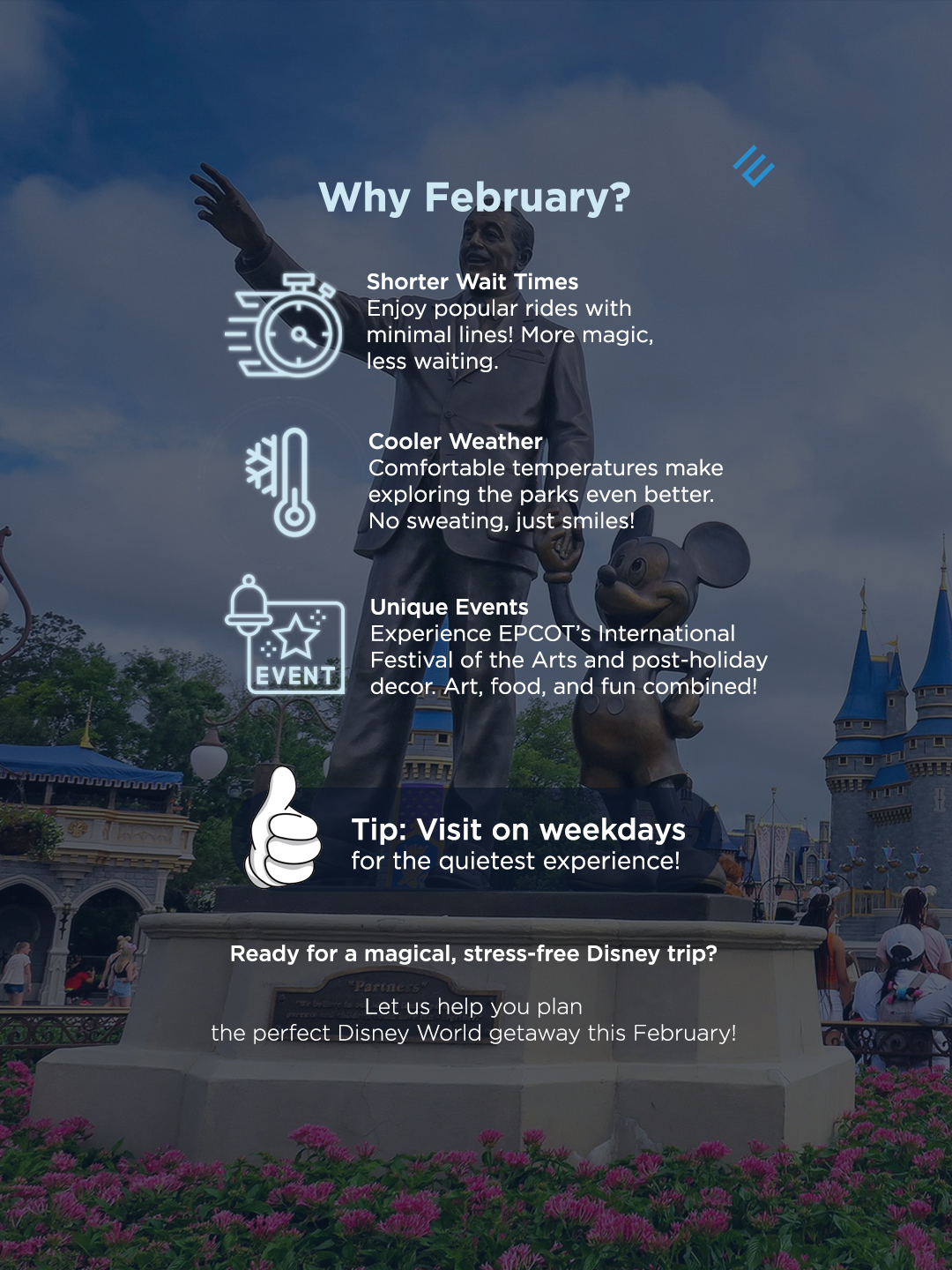
One of the most noticeable advantages of visiting Disney World in February is shorter wait times. Popular attractions that can take over an hour during peak season often drop to much more manageable waits.

This means:

  • More rides in a single day

  • Less time standing in lines

  • More flexibility to explore shows, parades, and character encounters

For families with children, this can be transformative. Less waiting means happier moods, more energy, and a smoother overall experience. For couples or solo travelers, it means freedom—to wander, explore, and enjoy the parks without pressure.

Cooler Weather, Greater Comfort - Ideal Temperatures for Exploring

Florida is known for its heat, but February offers a refreshing contrast. With cooler, more comfortable temperatures, exploring the parks becomes far more enjoyable. Long walks between lands feel easier, outdoor attractions are more pleasant, and even afternoons remain manageable.

This weather makes February especially appealing for:

  • Families with young children

  • Travelers sensitive to heat

  • Guests planning full park days

Instead of focusing on hydration breaks and shade, visitors can focus on the experience itself.

Energy That Lasts All Day

Cooler weather doesn’t just feel better—it helps maintain energy. Guests are less fatigued, more patient, and more open to spontaneous moments. Evenings feel inviting rather than exhausting, making nighttime shows and fireworks more enjoyable.

In February, Disney World feels designed for exploration rather than endurance.

Unique Seasonal Experiences in February - EPCOT International Festival of the Arts

One of February’s standout highlights is the EPCOT International Festival of the Arts. This event transforms EPCOT into a celebration of creativity, blending visual art, live performances, and culinary artistry.

Visitors can:

  • View works by Disney and international artists

  • Enjoy live Broadway-style performances

  • Taste artistically inspired food and beverages

The festival adds a sophisticated, cultural layer to the Disney experience—perfect for adults, couples, and families seeking something beyond rides.

Post-Holiday Visual Calm

By February, the parks have transitioned out of the intense holiday rush. Decorations are more subtle, and the overall atmosphere feels balanced. The result is a park environment that feels curated rather than crowded.

This quieter visual landscape allows guests to appreciate Disney’s storytelling and design at a deeper level.

Smart Planning Tips for February Visits - Visit on Weekdays

Even in February, crowd levels can vary. Weekdays—especially Tuesday through Thursday—tend to be the quietest. Planning park days during these times maximizes the benefits of the season.

Weekday visits often mean:

  • Even shorter wait times

  • Easier dining reservations

  • A calmer park atmosphere overall

Balance Park Time and Rest

With fewer crowds and better weather, it’s tempting to pack each day full. However, February is ideal for a balanced approach. Taking midday breaks, enjoying leisurely meals, or exploring resorts can enhance the experience rather than limit it.

A relaxed pace allows the magic to unfold naturally.

Who February Is Perfect For - Families Seeking Ease

For families, February reduces many common stress points. Shorter lines mean fewer meltdowns, and cooler weather keeps energy levels steady. Parents can focus on shared memories rather than crowd management.

Couples and Adult Travelers

February’s calmer atmosphere makes Disney World feel surprisingly romantic and refined. Strolling through EPCOT, enjoying festivals, and exploring themed dining experiences feels less rushed and more intentional.

First-Time Visitors

First-time guests often benefit most from February. With fewer crowds, navigating the parks feels less overwhelming, allowing new visitors to appreciate Disney’s scale and detail without feeling pressured.

When Timing Becomes the Magic

Disney World is magical year-round, but February unlocks a version of the parks that feels lighter, calmer, and more immersive. Shorter wait times, cooler weather, and unique seasonal events combine to create an experience that prioritizes joy over logistics.

For travelers who want to experience Disney World without the usual stress—who want more smiles and less standing still—February offers a rare opportunity.

Sometimes, the magic isn’t about doing more.
It’s about choosing the right moment.

And in February, Disney World shines just a little brighter—quietly, comfortably, and beautifully. 

Thoughtfully Designed Journeys, Just for You

Start planning your thoughtfully designed journey with Axcell Travel Destination.

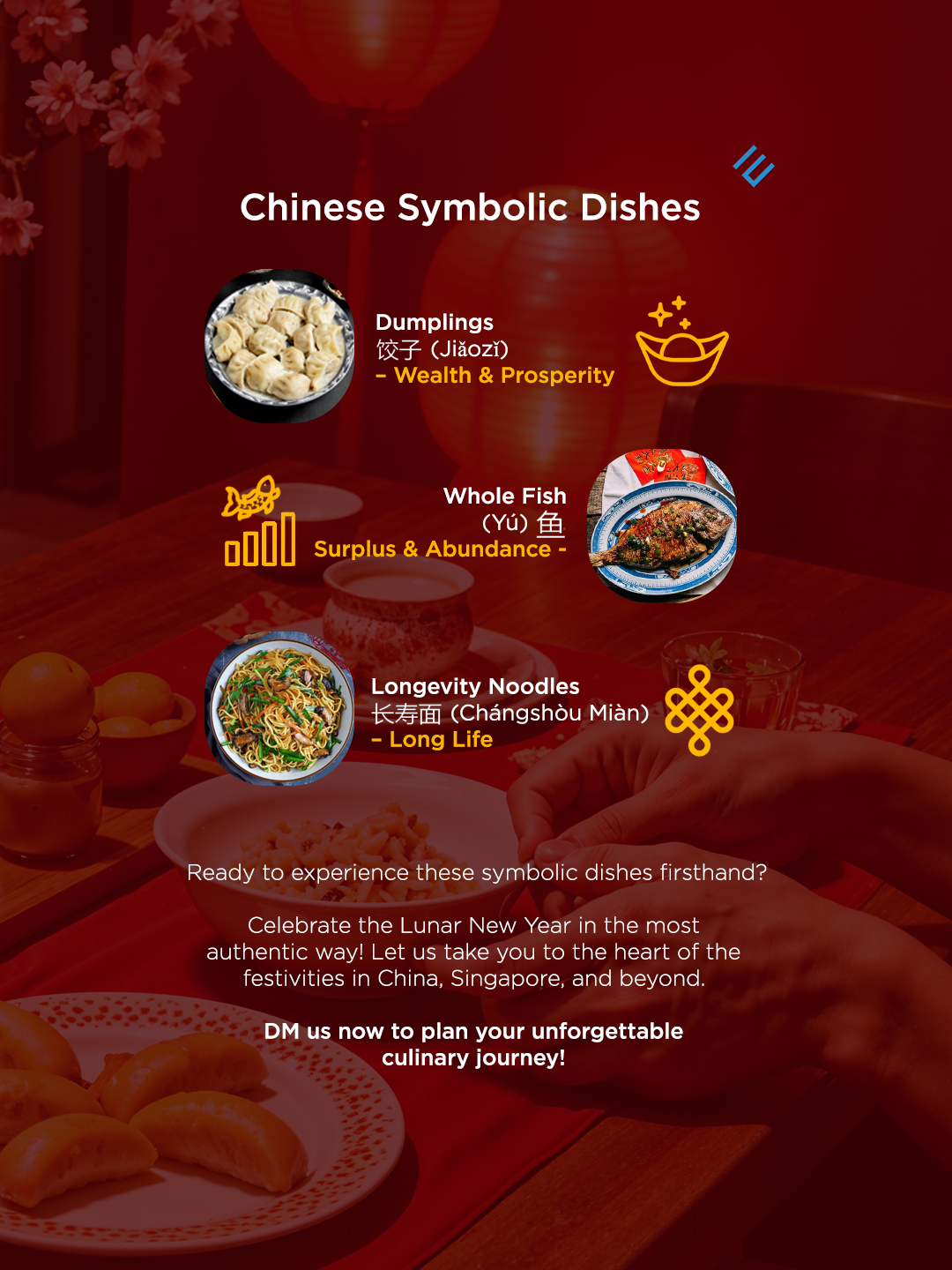
Symbolic Dishes You Must Try During Lunar New Year

When Food Becomes a Language of Hope, Blessings, and New Beginnings

Lunar New Year is more than a celebration—it is a deeply symbolic moment of renewal, reunion, and intention. Across homes, temples, and dining tables, traditions unfold with meaning passed down through generations. Among these traditions, food holds a central role, serving not only to nourish the body, but to communicate wishes for prosperity, longevity, and abundance in the year ahead.

During Lunar New Year, meals are never random. Every dish tells a story. Every ingredient carries a hope. To eat is to participate in a cultural language that speaks of family bonds, respect for ancestors, and optimism for the future.

From bustling family kitchens in China to vibrant communal feasts in Singapore, symbolic dishes unite people across regions and generations. To experience Lunar New Year fully is to understand what is served—and why.

Below are three symbolic dishes you must try during Lunar New Year, each representing a powerful blessing for the year to come.

Dumplings (饺子 | Jiǎozi) - Why Dumplings Matter

Dumplings are among the most iconic Lunar New Year foods, especially in northern China. Their shape resembles ancient Chinese silver ingots, once used as currency, making them a direct symbol of wealth and financial prosperity.

Eating dumplings during the New Year is believed to invite abundance and success. The more dumplings shared, the greater the hope for a prosperous year ahead.

But their symbolism goes beyond money. Dumplings also represent togetherness. Making them is often a family activity, where generations gather around a table to fold, fill, and seal each piece by hand.

A Ritual of Family and Intention

The act of preparing dumplings is as meaningful as eating them. Families often make them together on New Year’s Eve, talking, laughing, and sharing stories while working side by side. This collective effort reinforces unity—an essential value at the heart of Lunar New Year.

Some families hide a coin inside one dumpling. Whoever finds it is believed to receive extra luck in the coming year. The ritual transforms a simple meal into a moment of excitement and shared hope.

Regional Variations and Modern Takes

While traditional fillings include pork, cabbage, and chives, modern variations reflect regional flavors and creativity. Vegetarian dumplings, seafood fillings, and fusion styles have emerged, especially in cosmopolitan cities like Singapore.

Yet no matter the variation, the meaning remains unchanged: dumplings symbolize a wish for a year filled with opportunity and reward.

To taste dumplings during Lunar New Year is to taste optimism itself.

Whole Fish (鱼 | Yú) - The Power of a Single Word

In Chinese, the word for fish—“yú” (鱼)—sounds identical to the word for surplus. This linguistic connection turns fish into one of the most powerful symbols of Lunar New Year, representing abundance that carries over from one year to the next.

A common New Year’s blessing, “Nián nián yǒu yú” (年年有余), literally means “may you have surplus year after year.” Serving a whole fish transforms this phrase into something tangible.

Why the Fish Must Be Whole

During Lunar New Year, the fish is traditionally served whole—head, body, and tail intact. This represents completeness, continuity, and a strong beginning and ending to the year.

Often, the fish is intentionally not fully eaten. Leaving some behind symbolizes that abundance will remain, rather than being consumed entirely.

Presentation matters deeply. The fish is usually placed facing the guest of honor or eldest family member, reflecting respect and hierarchy—values that remain central in Lunar New Year celebrations.

Shared Meaning Across Regions

While preparation styles vary—steamed, braised, or baked—the symbolism of fish is shared across many Lunar New Year celebrations, from family homes in China to grand reunion dinners in Singapore.

Eating fish together reinforces the idea that prosperity is meant to be shared, not hoarded. It is a collective wish for stability, security, and generosity.

Longevity Noodles (长寿面 | Chángshòu Miàn) - More Than Just Noodles

Longevity noodles are instantly recognizable by their length. Unlike regular noodles, they are kept as long and unbroken as possible, symbolizing a wish for long life and enduring health.

During Lunar New Year, these noodles are served to elders as a sign of respect, but they are enjoyed by all as a shared hope for well-being in the year ahead.

The Rule - Never Cut the Noodles

One of the most important customs surrounding longevity noodles is that they should never be cut. Cutting the noodles is believed to symbolically shorten life.

Eating them requires patience and care—values closely tied to longevity itself. The act becomes a quiet lesson in mindfulness, reminding diners to slow down and savor both food and life.

A Dish of Respect and Blessing

Longevity noodles are often served in a simple broth or lightly stir-fried, allowing their form to remain intact. The simplicity emphasizes meaning over extravagance.

In Lunar New Year feasts, this dish is often accompanied by warm wishes spoken aloud, reinforcing its role as a blessing rather than just a meal.

Celebrating Through Food Across Borders - Lunar New Year Beyond One Place

While rooted in Chinese culture, Lunar New Year is celebrated across many countries, each adding local flavors while preserving symbolic meaning. In Singapore, for example, Lunar New Year feasts blend traditional symbolism with multicultural influences, reflecting the country’s diverse heritage.

The shared thread remains intention. Whether in a family kitchen, a temple courtyard, or a festive restaurant, the symbolism of food connects people to the past while guiding hopes for the future.

Food as Cultural Memory

These dishes are more than seasonal specialties. They are edible traditions—memories carried through taste, texture, and ritual. For many families, preparing and eating these foods is how culture is passed down, one generation at a time.

Travelers who experience Lunar New Year through its cuisine gain access to this deeper cultural layer, one that cannot be found in guidebooks alone.

Eating with Meaning

During Lunar New Year, food becomes a language of blessing. Dumplings speak of prosperity. Fish promises abundance. Longevity noodles offer wishes of health and time.

To eat these dishes is not just to participate in a celebration, but to take part in a shared cultural hope for the year ahead. Each bite carries intention, memory, and connection.

For travelers seeking authentic experiences, celebrating Lunar New Year through its symbolic dishes offers something rare: a chance to understand culture not by observing it, but by tasting it.

Because during Lunar New Year, what you eat matters—
and what it means matters even more.

Thoughtfully Designed Journeys, Just for You

Start planning your thoughtfully designed journey with Axcell Travel Destination.

Travel Tip | Take Quick Naps Whenever Possible

The Simple Habit That Can Transform Your Energy, Mood, and Travel Experience

Travel is exciting—but it can also be exhausting. Early flights, long layovers, time zone changes, packed itineraries, and constant stimulation can quietly drain your energy before you even realize it. Many travelers try to push through fatigue with coffee, sugar, or sheer willpower, only to end the day feeling irritable, unfocused, and overwhelmed.

There is, however, a surprisingly simple habit that seasoned travelers swear by—one that doesn’t require special gear, extra planning, or cutting experiences short.

Quick naps

Not long sleeps. Not disappearing for hours. Just short, intentional rests that allow your body and mind to reset. When done correctly, quick naps can become one of the most powerful tools for stress-free, energized travel.

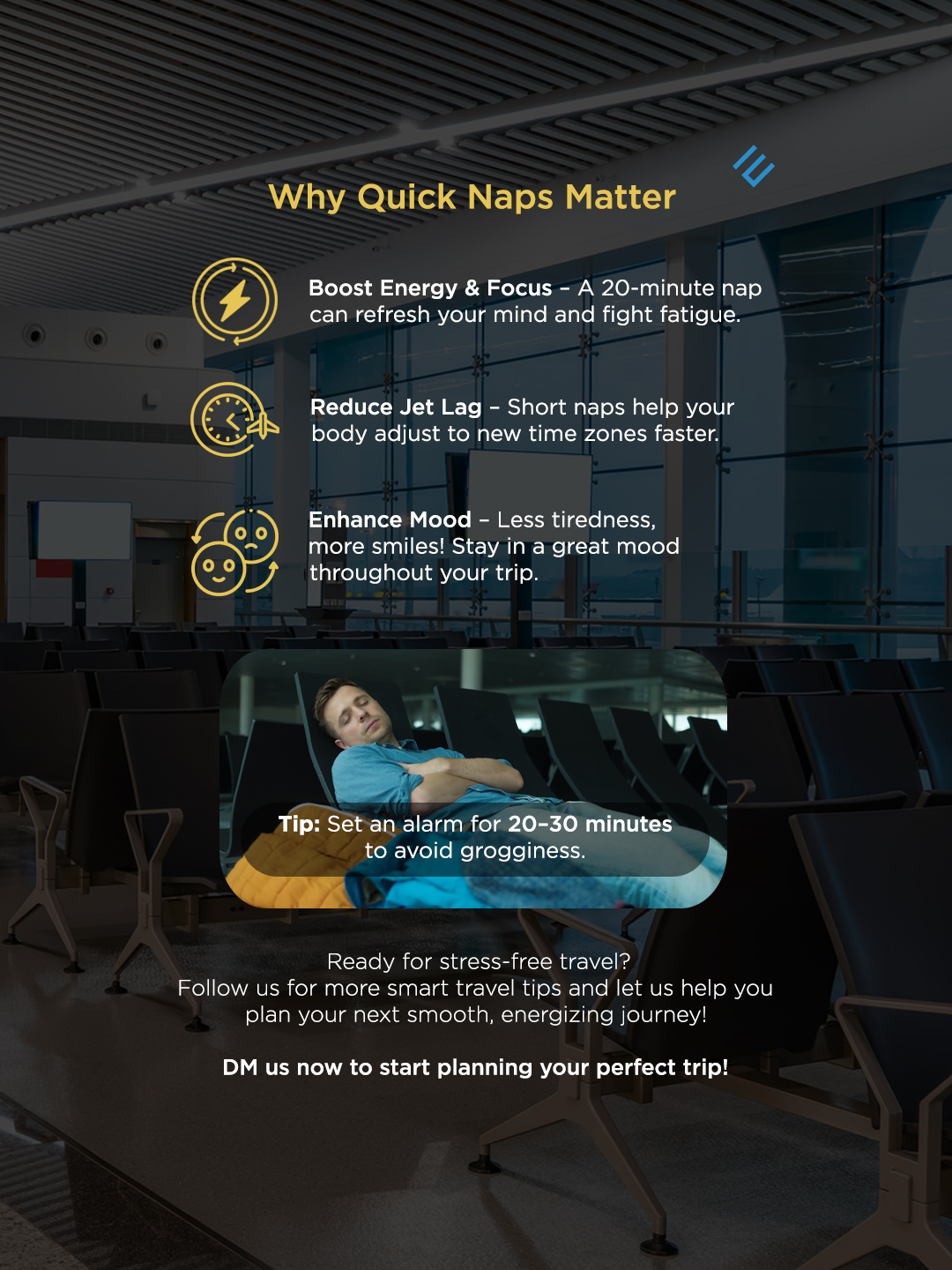
Why Quick Naps Matter While Traveling - Travel Fatigue Is Real

Travel disrupts nearly every routine your body relies on—sleep schedules, meal times, activity levels, and even exposure to light. Add unfamiliar environments and constant movement, and fatigue becomes inevitable.

Ignoring that fatigue doesn’t make it disappear. It often shows up later as headaches, irritability, poor focus, or low motivation—exactly the things that can turn an amazing trip into a tiring one.

Quick naps work because they interrupt this downward spiral early.

Boosting Energy Without Losing Time

One of the biggest misconceptions about naps is that they “waste time.” In reality, a 20-minute nap can give you more usable energy than pushing through exhaustion for hours.

Short naps allow the brain to rest without entering deep sleep. This means you wake up refreshed rather than groggy, ready to continue exploring, socializing, or navigating travel logistics with clarity.

Think of quick naps as energy investments, not breaks.

Boost Energy & Focus - Mental Sharpness on the Road

Travel demands constant decision-making—finding directions, reading schedules, managing documents, adjusting plans. Fatigue dulls these skills quickly.

A short nap helps reset attention and focus, improving:

  • Memory and awareness

  • Reaction time

  • Problem-solving ability

This is especially valuable during travel days, city-hopping itineraries, or excursions that require concentration.

Better Experiences, Not Just More Activities

Being awake doesn’t always mean being present. Many travelers “see” places without truly experiencing them because they are too tired to absorb details.

Quick naps help you re-engage. Colors appear sharper, conversations feel easier, and moments feel more vivid. Instead of rushing from place to place on autopilot, you experience destinations with intention and clarity.

Reducing Jet Lag the Smart Way - Why Jet Lag Hits So Hard

Jet lag happens when your internal clock is out of sync with your destination. Long naps or irregular sleeping patterns can make this worse by confusing your body even further.

Quick naps, on the other hand, support gradual adjustment.

Short Naps as Time-Zone Bridges

A brief nap helps relieve overwhelming sleep pressure without pushing your body into deep rest at the wrong time. This makes it easier to:

  • Stay awake until local bedtime

  • Adapt to daylight cues

  • Reset your internal rhythm more smoothly

Instead of crashing mid-afternoon or staying wide awake at night, your body learns the new schedule gently.

Strategic Rest Beats Over-Sleeping

The goal isn’t to sleep whenever you’re tired—it’s to sleep intentionally. Short naps give relief without sabotaging nighttime rest, making them one of the most effective tools against jet lag.

Enhancing Mood While You Travel - The Emotional Side of Tiredness

Fatigue doesn’t just affect your body—it affects your emotions. When you’re tired, you’re more likely to feel:

  • Irritable

  • Anxious

  • Overwhelmed

  • Less patient with delays or crowds

This can quietly erode travel enjoyment, even in beautiful places.

Quick Naps as Mood Reset Buttons

A short nap helps regulate emotional responses. Many travelers report feeling calmer, more positive, and more flexible after resting briefly.

This matters when:

  • Flights are delayed

  • Weather changes plans

  • Crowds become overwhelming

Instead of reacting emotionally, you respond calmly—keeping the trip enjoyable for yourself and those around you.

How to Nap the Right Way While Traveling - The Ideal Nap Length

The sweet spot for travel naps is 20–30 minutes. This allows mental recovery without entering deep sleep.

Tip: Always set an alarm. Even if you don’t fall fully asleep, resting with eyes closed still provides benefits.

Best Times to Nap

Quick naps work best:

  • Midday to early afternoon

  • After long travel segments

  • Before evening activities, not late at night

Avoid napping too close to bedtime, as this may interfere with night sleep.

Where to Nap on the Go

You don’t need a bed. Quick naps can happen:

  • On flights or trains

  • In hotel rooms

  • At airports during layovers

  • In quiet cafés, parks, or lounges

Comfort matters less than quiet and intention.

Changing Your Travel Mindset - Letting Go of the “Do Everything” Mentality

Many travelers feel guilty resting—afraid of missing out. But constant activity often leads to burnout, not fulfillment.

Quick naps allow you to:

  • Travel longer without exhaustion

  • Enjoy evenings instead of crashing early

  • Stay present throughout the trip

Rest doesn’t reduce your experience—it protects it.

Travel Smarter, Not Harder

Experienced travelers know that pacing matters. They build rest into their journeys, not as an afterthought, but as a strategy.

Quick naps are one of the easiest ways to travel smarter—requiring no extra cost, planning, or sacrifice.

Small Pauses Create Better Journeys

Quick naps may seem insignificant, but their impact is anything but small. They sharpen your focus, stabilize your mood, reduce jet lag, and help you enjoy travel with more energy and intention.

In a world that celebrates constant movement, choosing to pause—briefly and mindfully—can be the most powerful travel decision you make.

Travel isn’t just about where you go.
It’s about how you feel while you’re there.

And sometimes, the best way to move forward…
is to rest for just a moment.

Thoughtfully Designed Journeys, Just for You

Start planning your thoughtfully designed journey with Axcell Travel Destination.

Experience Hong Kong’s International Chinese New Year Night Parade

Where Tradition, Performance, and Modern Spectacle Ignite the City

Few cities celebrate the Lunar New Year with the same scale, energy, and global flair as Hong Kong. When the International Chinese New Year Night Parade takes over the streets, the city transforms into a living stage—where ancient traditions meet world-class performance, and where celebration spills from the ground into the sky.

This is not just a festival; it is a statement. A declaration that the New Year has arrived with color, rhythm, and collective joy. For travelers, witnessing this event is more than attending a parade—it is stepping into one of Asia’s most iconic cultural moments.

The Spirit of the Night Parade - A Festival with International Soul

The International Chinese New Year Night Parade is one of Hong Kong’s most anticipated annual events. Unlike traditional parades confined to local customs, this celebration brings together performers from around the world—blending Chinese heritage with international creativity.

As the procession winds through the streets of Tsim Sha Tsui, the atmosphere feels electric. Music pulses, lights shimmer, and the city’s multicultural identity comes alive. The parade reflects Hong Kong itself: dynamic, diverse, and deeply connected to tradition while embracing the modern world.

Why This Parade Feels Different

What sets this parade apart is its scale and choreography. Every element—costumes, floats, music, movement—is carefully designed to tell a story of renewal, prosperity, and shared celebration. The streets become immersive, inviting spectators not just to watch, but to feel part of something larger.

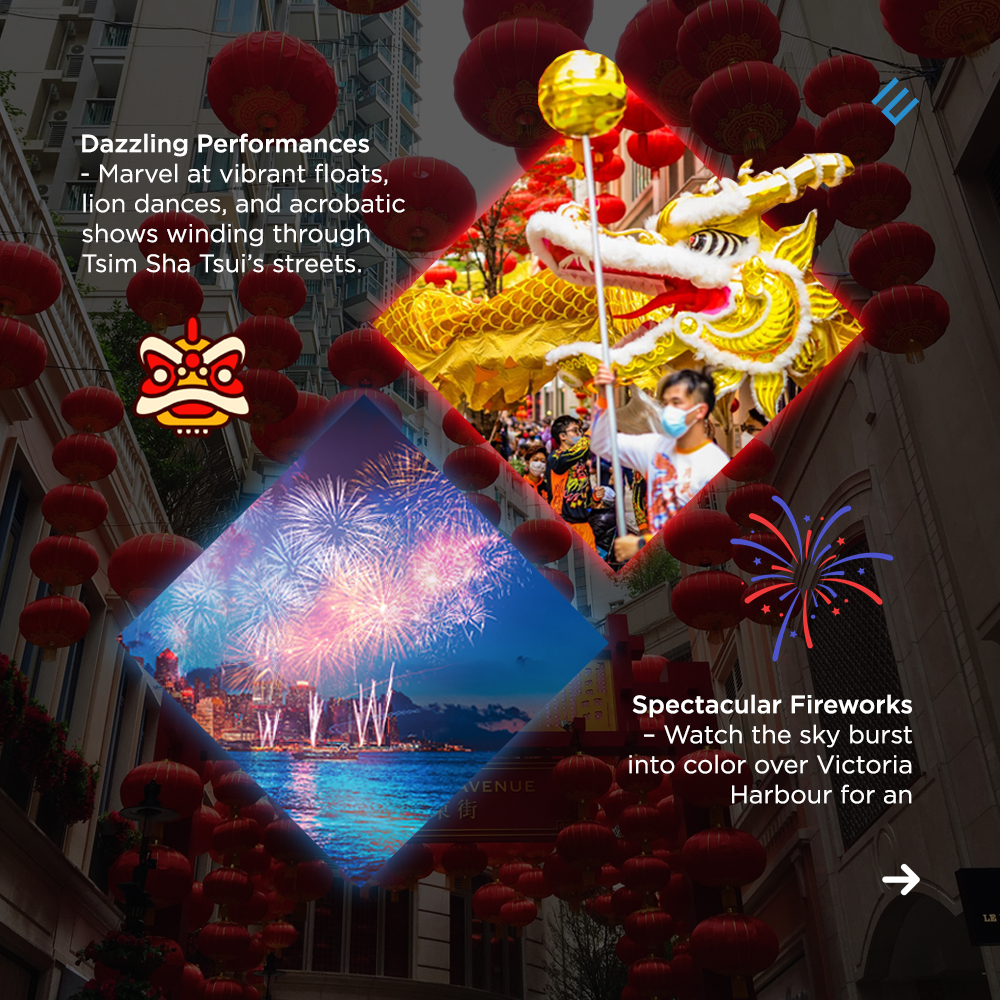
Dazzling Performances on the Streets - Floats That Tell Stories

One of the most captivating elements of the parade is its vibrant floats. Towering, illuminated, and intricately designed, they glide through the streets like moving works of art. Each float reflects themes of luck, prosperity, mythology, and modern creativity, combining traditional symbolism with contemporary design.

As they pass, the crowd reacts instinctively—phones rise, voices cheer, and eyes follow every detail. These floats are not static displays; they are kinetic storytelling, designed to be experienced in motion.

Lion Dances and Acrobatic Mastery

No Chinese New Year celebration would be complete without the iconic lion dance. In Hong Kong’s night parade, these performances are elevated to another level. Powerful drumbeats echo through the streets as lions leap, spin, and interact with the crowd, symbolizing good fortune and protection for the year ahead.

Acrobatic troupes add another layer of excitement. With precision and strength, performers execute gravity-defying movements that blur the line between athleticism and art. The result is a parade that feels alive—unpredictable, exhilarating, and deeply engaging.

A Sensory Experience

Sound, light, and movement work together seamlessly. Neon hues reflect off surrounding buildings, music reverberates through narrow streets, and the collective energy of spectators fuels the momentum. It is a celebration that demands attention, drawing everyone into its rhythm.

Fireworks Over Victoria Harbour - A Signature Hong Kong Moment

As the parade concludes, the celebration continues above one of the world’s most iconic skylines. Fireworks burst over Victoria Harbour, illuminating skyscrapers, water, and sky in synchronized brilliance.

The fireworks display is more than a visual spectacle—it is a symbolic welcome to the New Year. Each burst represents hope, prosperity, and renewal, mirrored across the harbor’s shimmering surface.

Why This View Is Unforgettable

Watching fireworks over Victoria Harbour offers a sense of scale that few cities can match. The contrast between modern architecture and traditional celebration reinforces Hong Kong’s unique identity—a place where history and progress coexist effortlessly.

The experience feels communal. Strangers gather side by side, sharing silence between explosions and collective awe as the sky blooms with color.

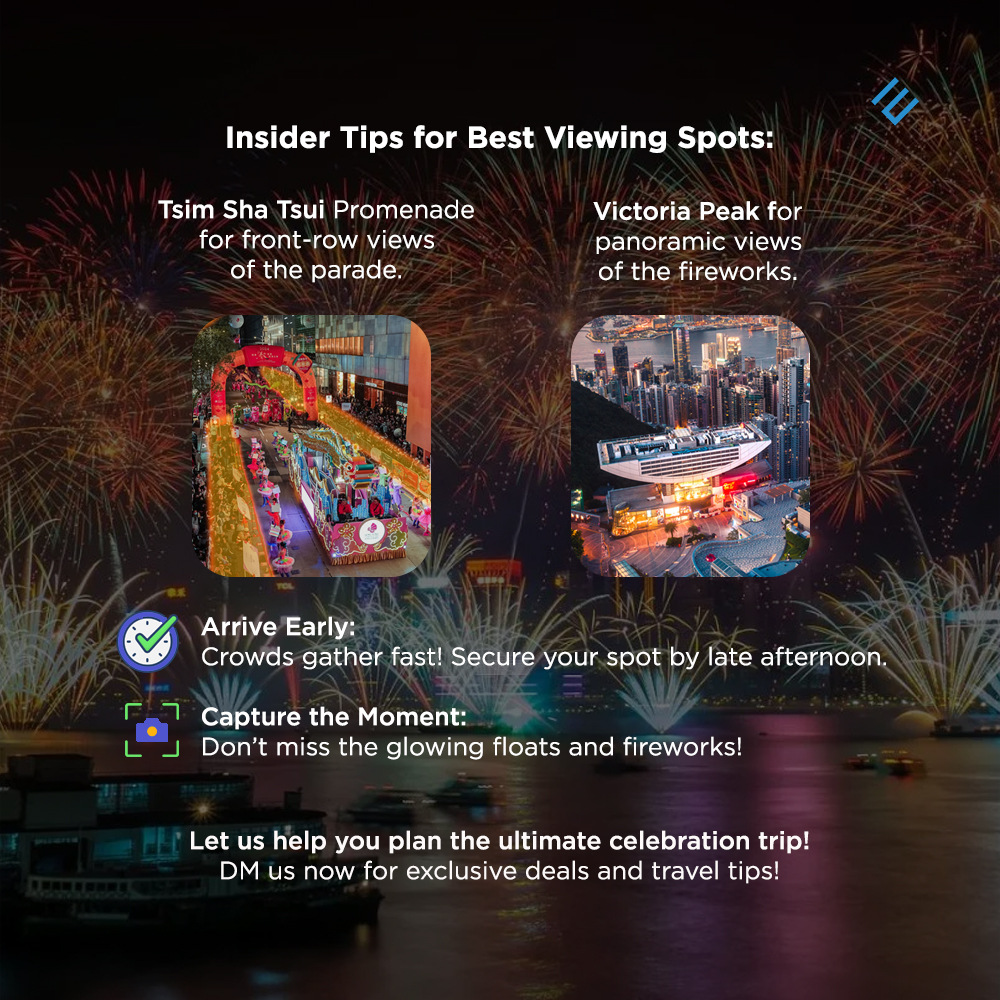
Insider Tips for the Best Viewing Experience | Tsim Sha Tsui Promenade - Front-Row Energy

For those who want to feel the heartbeat of the parade, Tsim Sha Tsui Promenade offers prime positioning. Here, you are close enough to see performers’ expressions, hear the drums reverberate, and feel the momentum of the procession.

This area is ideal for capturing detailed photos of floats and performances, making it a favorite for first-time visitors.

Victoria Peak - Panoramic Fireworks Views

For a broader perspective, Victoria Peak provides sweeping views of the fireworks and skyline. While you won’t see the parade itself, the elevated vantage point offers a serene yet dramatic way to experience the celebration from above.

This option suits travelers who prefer atmosphere over proximity—trading street-level energy for panoramic beauty.

Practical Tips for a Seamless Experience - Arrive Early, Move Lightly

Crowds gather quickly, especially in popular viewing areas. Arriving by late afternoon ensures a good vantage point and reduces stress. Comfortable footwear, light layers, and minimal belongings help you navigate the festivities with ease.

Capture the Moment—Mindfully

The glowing floats and fireworks offer countless photo opportunities, but it’s worth balancing documentation with presence. Some moments are best remembered not through a lens, but through feeling—the rhythm of drums, the warmth of the crowd, the shared excitement of the countdown.

A Celebration That Defines Hong Kong

The International Chinese New Year Night Parade is more than an event—it is a reflection of Hong Kong’s spirit. Bold yet respectful of tradition. Global yet deeply rooted. Energetic yet meaningful.

For travelers, experiencing this celebration offers insight into how a city welcomes new beginnings—with creativity, inclusivity, and unmistakable flair. It is a reminder that festivals are not just about marking time, but about bringing people together through shared emotion and wonder.

If the New Year represents renewal, then few places welcome it with as much brilliance as Hong Kong—where the streets dance, the harbor glows, and the future arrives in a burst of light.

Thoughtfully Designed Journeys, Just for You

Start planning your thoughtfully designed journey with Axcell Travel Destination.

Set Sail in Style – Luxurious Cruise Ships are the Top Travel Trend in 2025

Why Luxurious Cruise Ships Are the Top Travel Trend in 2025

Travel in 2025 is no longer just about where you go—it’s about how you experience the journey. As travelers seek comfort, personalization, and immersive experiences without sacrificing ease, one travel style has risen above the rest: luxury cruising.

Modern cruise ships have evolved far beyond traditional expectations. They are no longer simply vessels that move between destinations; they are floating resorts, culinary hubs, wellness sanctuaries, and curated worlds designed to deliver effortless elegance. From private plunge pools overlooking endless horizons to Michelin-star dining and personalized butler service, cruising has become a statement of refined travel.

In an era where time is precious and experiences matter, luxury cruise ships offer something uniquely compelling: the ability to explore the world while feeling entirely at home.

The Rise of Luxury Cruising in 2025 - A New Definition of Travel

Luxury cruising has surged in popularity because it answers a modern traveler’s most important desires: seamless movement, curated comfort, and meaningful experiences. Instead of unpacking at every stop or navigating complex logistics, travelers can settle into a beautifully designed space and let the world come to them.

In 2025, cruise ships are designed to rival—and often surpass—five-star resorts. Architecture, interior design, and onboard experiences are carefully curated to appeal to travelers who value privacy, exclusivity, and personalization.

The appeal lies in balance. A cruise allows exploration without exhaustion, variety without chaos, and indulgence without compromise. It is travel that flows.

Why Cruises Fit the Modern Lifestyle

Today’s travelers are more intentional. They want experiences that feel tailored, not generic. Luxury cruise ships respond with flexible itineraries, curated shore experiences, and onboard offerings that adapt to individual preferences.

Whether traveling as a couple, a family, or a multigenerational group, cruising offers something rare: shared experiences without forcing everyone into the same rhythm. Each guest can engage at their own pace, while still coming together for moments that matter.

Private Plunge Pools & Elevated Living - Suites That Feel Like Private Villas

One of the most defining features of luxury cruise ships in 2025 is the rise of private plunge pools and expansive suite accommodations. These are not simply cabins—they are personal sanctuaries designed for privacy, space, and uninterrupted views of the ocean.

Stepping into a suite with a private plunge pool feels less like boarding a ship and more like entering a private villa that just happens to float. Morning swims overlooking open seas, quiet evenings beneath the stars, and uninterrupted solitude redefine what “cruise living” means.

Privacy as the Ultimate Luxury

In a world that feels increasingly crowded, privacy has become the most sought-after luxury. Cruise designers understand this shift. Dedicated suite-only areas, private decks, exclusive lounges, and personalized access points ensure that guests can retreat whenever they wish.

This focus on privacy transforms the cruise experience from social to intentional—allowing travelers to choose when to engage and when to simply be.

Gourmet Dining at Sea - Michelin-Star Experiences Onboard

Food has become a central pillar of luxury travel, and cruise ships are no exception. In 2025, gourmet dining onboard luxury vessels is led by Michelin-star chefs, offering menus that rival the world’s top restaurants.

Each dining experience is carefully curated—seasonal ingredients, regional inspirations, and artistic presentation combine to create meals that feel memorable rather than routine. Dining is no longer an amenity; it is an experience in itself.

Choice, Variety, and Intimacy

Unlike traditional dining rooms, modern cruise ships offer a range of culinary settings: intimate chef’s tables, open-kitchen concepts, fine-dining restaurants, and relaxed yet refined bistros. Guests can choose formality or comfort, experimentation or familiarity.

The ability to enjoy world-class cuisine without leaving the ship elevates cruising into a complete sensory journey.

Wellness, Spas, and the Art of Slowing Down - Floating Wellness Sanctuaries

Luxury cruises in 2025 place wellness at the heart of the journey. State-of-the-art spas, ocean-facing treatment rooms, hydrotherapy pools, and holistic wellness programs are now standard features rather than extras.

Treatments often incorporate global wellness philosophies—combining modern science with ancient practices. The setting amplifies the experience: gentle waves, open horizons, and the subtle rhythm of the sea create a natural sense of calm.

A New Rhythm of Rest

Cruising allows travelers to reset their internal pace. Without rigid schedules or constant movement, guests are free to follow natural rhythms—sleeping deeply, eating mindfully, and spending time in quiet reflection.

Wellness onboard is not about transformation; it is about restoration.

Personalized Butler Service - Service That Anticipates, Not Interrupts

Personalized butler service has become a defining feature of luxury cruising. Rather than formal or intrusive, this service is subtle and intuitive—anticipating needs before they are spoken.

From arranging private dining and spa reservations to customizing in-suite experiences and shore excursions, butlers act as personal concierges who ensure every detail aligns with the guest’s preferences.

Effortless Luxury

True luxury is effortlessness. Butler service removes friction from travel, allowing guests to focus entirely on enjoyment. Decisions become lighter, time feels more spacious, and the journey unfolds smoothly.

Disney Adventure Cruise: Where Luxury Meets Magic - A New Chapter in Cruising

For travelers seeking a blend of luxury, storytelling, and world-class service, Disney Cruise Line introduces a new era with the Disney Adventure. Designed for 2025–2026 voyages, this ship reimagines what a Disney cruise can be—elegant, immersive, and refined.

Disney Adventure brings together sophisticated design, exceptional dining, expansive entertainment spaces, and thoughtfully curated experiences that appeal to both families and adults. It is not about excess—it is about balance, where imagination meets comfort.

A Journey Designed to Feel Magical

From beautifully designed staterooms to world-class dining and entertainment, Disney Adventure offers a cruise experience that feels both elevated and joyful. Every element is carefully considered, ensuring that the journey feels seamless and memorable.

For many travelers, this represents the future of cruising: experiences that feel magical without sacrificing luxury.

Why Luxury Cruising Defines Travel in 2025

Luxury cruise ships represent a shift in how we define travel success. It is no longer about how many places we see, but how deeply we experience them—and how we feel along the way.

Cruising in 2025 offers a rare harmony: movement without stress, indulgence without excess, and exploration without exhaustion. It allows travelers to reclaim time, comfort, and presence—all while surrounded by beauty.

Whether drawn by private plunge pools, gourmet dining, restorative spas, personalized service, or the enchanting promise of voyages like Disney Adventure, one truth is clear:

The future of travel is not faster—it is finer. And it sets sail.

Thoughtfully Designed Journeys, Just for You

Start planning your thoughtfully designed journey with Axcell Travel Destination.

Discover the Enchanted Mountains of Zhangjiajie

Where Stone Pillars Rise Like Myths and Nature Feels Otherworldly

There are landscapes that feel impressive, and then there are landscapes that feel unreal. Zhangjiajie belongs firmly to the second category. Here, thousands of towering sandstone pillars rise straight from the earth, wrapped in mist and shifting light, creating a world that feels suspended between reality and imagination.

Often described as otherworldly, Zhangjiajie is not simply a destination—it is an experience of scale, silence, and awe. This is a place where nature dominates the senses, where perspectives change with every step, and where the mountains themselves seem to tell ancient stories shaped by time.

For travelers seeking adventure infused with wonder, Zhangjiajie offers a journey into one of China’s most extraordinary natural landscapes.

Zhangjiajie | A Landscape Like No Other - A World Shaped by Time

Zhangjiajie’s dramatic scenery is the result of millions of years of erosion, carving vertical quartz-sandstone pillars that soar hundreds of meters into the sky. Covered with vegetation and often veiled in mist, these formations create a constantly shifting panorama—one moment sharp and imposing, the next softened into silhouettes.

What sets Zhangjiajie apart is its sense of verticality. Unlike rolling mountain ranges, this landscape rises suddenly and decisively. Valleys plunge deep below viewing platforms, while peaks stretch upward like stone forests reaching for the clouds. The scale feels both humbling and cinematic.

It is no surprise that this terrain inspired fantastical worlds in modern storytelling. Yet long before global recognition, these mountains were already sacred to those who lived among them—symbols of endurance, balance, and harmony between earth and sky.

Bailong Lift - The World’s Tallest Outdoor Elevator

One of Zhangjiajie’s most remarkable experiences begins not with a hike, but with ascent aboard the Bailong Elevator. Built directly into the cliff face, this glass elevator rises over 300 meters, transporting visitors from forest floor to mountaintop in just over a minute.

The journey itself is breathtaking. As the elevator climbs, the world below falls away, revealing sheer rock walls and dense greenery clinging impossibly to stone. The sensation is both thrilling and surreal—a reminder of human ingenuity set delicately within an overwhelming natural environment.

A Gateway to the High Plateaus

More than a convenience, the Bailong Lift serves as a gateway to Zhangjiajie’s upper realms. It allows visitors to reach elevated viewpoints that would otherwise require long, strenuous climbs, making the park’s most dramatic landscapes accessible while preserving their sense of grandeur.

Stepping out at the top feels like crossing into another world—one suspended above the forest, where clouds drift at eye level and stone pillars stand like sentinels.

Yuanjiajie - The Iconic Heart of Zhangjiajie

Perhaps the most recognizable area in the park, Yuanjiajie is where Zhangjiajie’s dreamlike quality becomes unmistakable. Narrow pathways wind between towering pillars, offering viewpoints that reveal endless layers of rock rising from deep valleys.

This area gained international fame for inspiring fantastical landscapes in popular culture, but its true power lies in presence. Standing on a viewing platform in Yuanjiajie, surrounded by pillars fading into mist, the boundary between reality and imagination blurs.

A Lesson in Perspective

Yuanjiajie invites stillness. The changing light, drifting clouds, and vast silence encourage visitors to pause rather than rush. Every angle offers a different composition, reminding travelers that perspective is fluid—and that beauty often reveals itself slowly.

Walking here feels less like sightseeing and more like wandering through a living painting.

Helong Park - Where Landscape Meets Legacy

Perched high within the Tianzi Mountain area, Helong Park combines natural grandeur with historical significance. Named after Marshal He Long, a prominent figure in Chinese history, the park blends monument, memory, and mountain scenery.

Statues and memorials stand quietly against the vast backdrop, offering moments of reflection amid sweeping views. From this vantage point, layers of peaks stretch into the distance, creating one of Zhangjiajie’s most expansive panoramas.

A Place to Pause

Helong Park is less crowded than other highlights, making it ideal for unhurried exploration. Benches invite rest, while viewpoints encourage contemplation. Here, the mountains feel less dramatic and more dignified—less like spectacle, more like presence.

Tianzi Mountain - The Emperor of Peaks

Known for its ever-changing weather and ethereal atmosphere, Tianzi Mountain is often considered the soul of Zhangjiajie. Clouds roll in without warning, transforming familiar views into dreamlike scenes where peaks appear and disappear in silence.

Tianzi Mountain is famous for its “sea of clouds,” a phenomenon that makes stone pillars look as though they are floating above the world. Early mornings and late afternoons are especially magical, when light filters through mist and shadows stretch across the valleys.

Beauty in Impermanence

What makes Tianzi Mountain unforgettable is its unpredictability. No two visits are the same. The landscape shifts constantly, reminding travelers that nature is not static—and that beauty often lies in moments that cannot be planned.

Here, patience is rewarded. Waiting becomes part of the experience.

When Adventure Becomes Awe

Zhangjiajie is not a destination you simply visit—it is a place you absorb. From the thrilling ascent of the Bailong Lift to the dreamlike paths of Yuanjiajie, the quiet dignity of Helong Park, and the misty poetry of Tianzi Mountain, every element works together to reshape perspective.

This is a landscape that reminds us how small we are, and how powerful nature can be—not through force, but through time, balance, and beauty.

For those drawn to places that feel enchanted rather than engineered, Zhangjiajie offers an adventure that lingers long after the mountains fade from view.

Your next adventure doesn’t just await—it rises before you, pillar by pillar, in the enchanted mountains of Zhangjiajie.

Thoughtfully Designed Journeys, Just for You

Start planning your thoughtfully designed journey with Axcell Travel Destination.

January in Ubud

A Peaceful Start to Your Year

The beginning of a new year often arrives with noise—resolutions spoken too loudly, schedules filled too quickly, and expectations that demand immediate momentum. Yet not every beginning needs urgency. Some beginnings are meant to be gentle.

In Ubud, January unfolds slowly. Mornings arrive wrapped in mist, afternoons settle into warm stillness, and the island’s cultural heart returns to its most nurturing rhythm. This is not Bali at its most energetic or festive—but Bali at its most grounding.

For travelers seeking balance rather than distraction, January in Ubud offers something rare: a chance to begin the year by reconnecting with body, mind, and nature.

January Atmosphere in Ubud - A Climate That Encourages Slowness

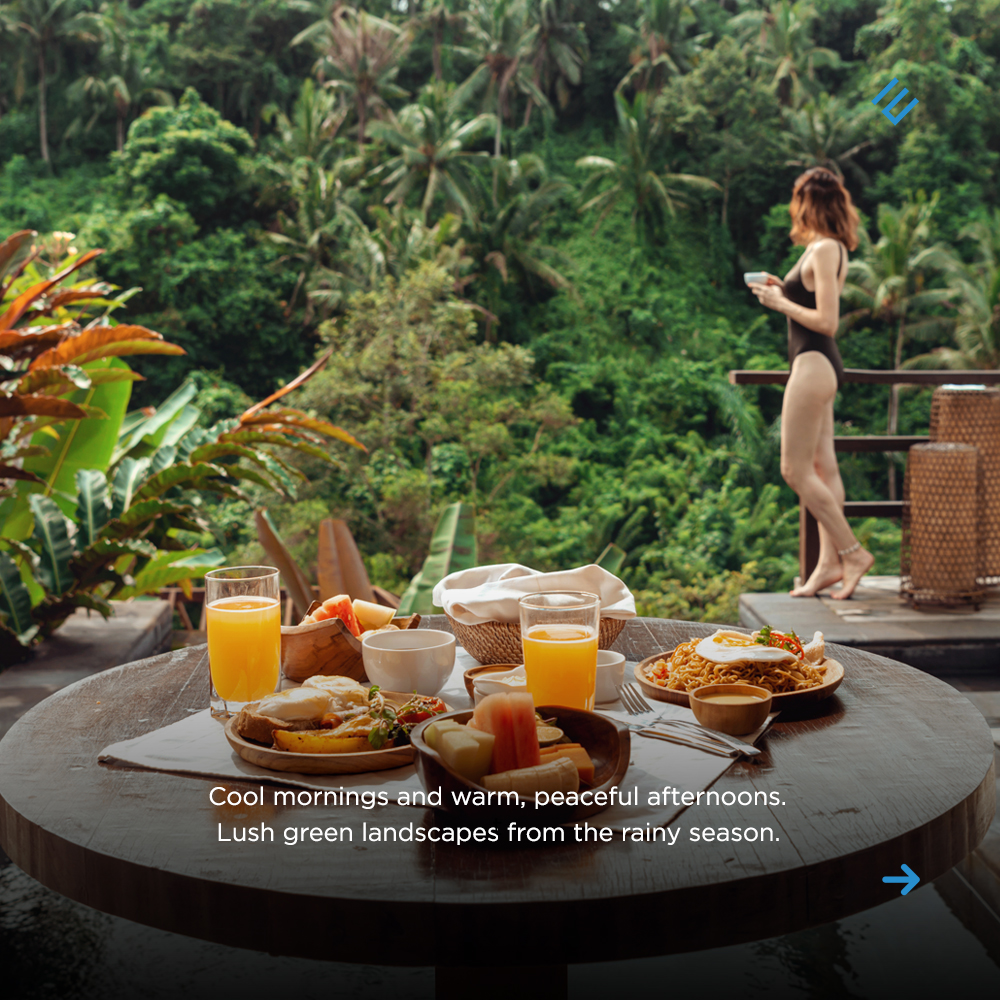
January in Ubud sits gently between seasons. Mornings are cool and fresh, often accompanied by soft rain or lingering mist that drifts through the valleys. Afternoons warm gradually, never rushed, inviting unhurried walks, quiet café visits, or time spent simply observing the surroundings.

This balance creates an ideal rhythm for rest and reflection. The air feels cleaner after rainfall, the light softer, and the pace naturally slower. Instead of planning days around heat or crowds, travelers find themselves moving intuitively—resting when the rain falls, exploring when the sky opens.

Lushness at Its Peak

The rainy season transforms Ubud into a living palette of green. Rice terraces glow intensely, jungle foliage thickens, and rivers flow with renewed energy. Nature feels active, present, and generous.

Rather than limiting experience, the rain enhances it. The sound of water becomes part of daily life—rain on leaves, streams swelling, distant thunder rolling softly through the hills. This constant presence of nature reinforces Ubud’s role not just as a destination, but as an environment that holds and supports those within it.

In January, Ubud feels less curated and more alive.

Why Ubud Is the Perfect January Escape - Yoga and Meditation as Daily Rhythm

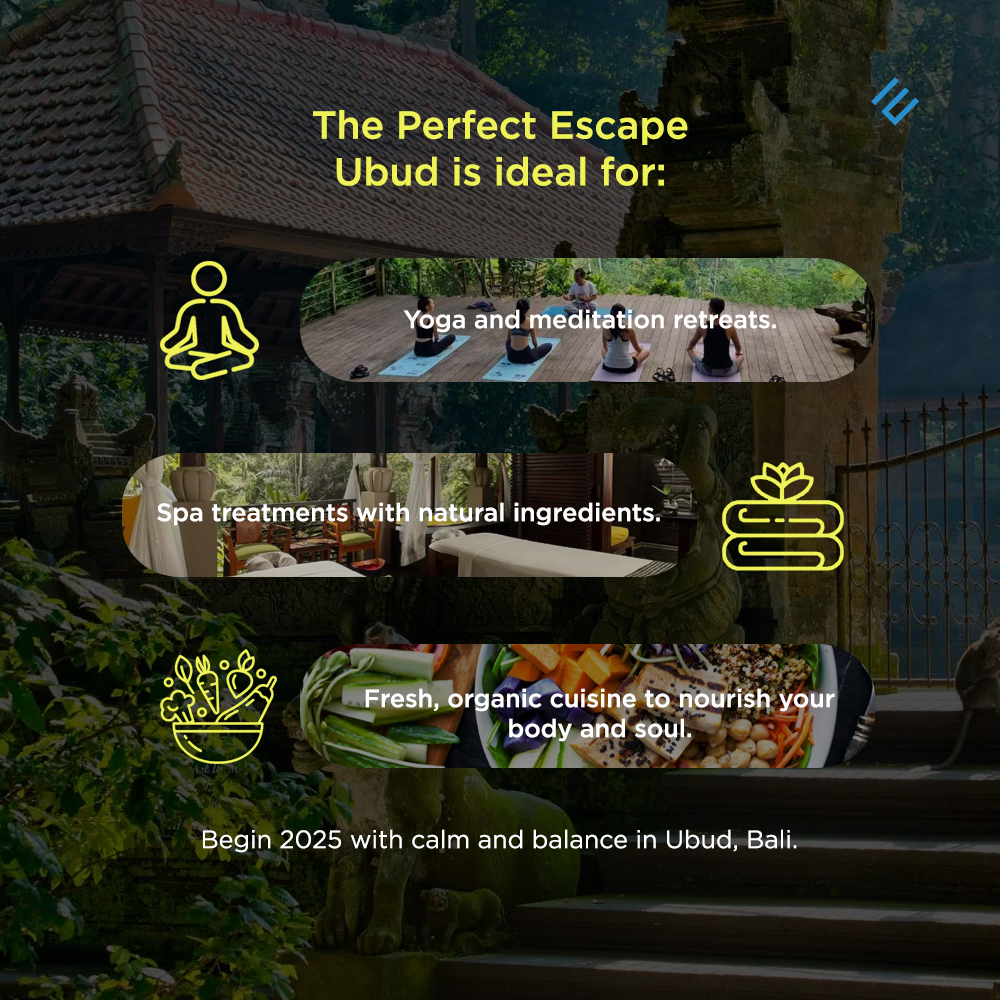
Ubud’s reputation as a wellness sanctuary is deeply rooted, and January is one of the most rewarding times to experience it. Without peak-season crowds, yoga studios and retreat centers feel intimate and focused. Classes become quieter, instructors more attentive, and practice more personal.

Morning sessions often begin with mist still rising from the fields, creating a sense of calm even before movement begins. Meditation here feels less like an activity and more like a natural response to the environment. Silence is not enforced—it is offered.

For many travelers, this creates space for intention-setting rather than goal-setting. The year begins not with pressure, but with awareness.

Spa Rituals Inspired by Nature

January’s cooler air makes spa treatments especially inviting. Ubud’s spas emphasize natural ingredients—herbs, flowers, oils, and clays sourced locally and prepared with care. Treatments are not rushed, nor purely aesthetic. They are designed to restore balance, release tension, and reconnect the body with its natural rhythms.

Rain outside treatment rooms only enhances the experience. The sound becomes part of the ritual, reinforcing the sense of shelter and stillness. These moments are not indulgences; they are acts of recalibration.

Nourishment Beyond the Plate

Food in Ubud during January reflects the same philosophy of balance. Fresh, organic cuisine takes center stage—simple yet nourishing, designed to support both physical health and mental clarity.

Meals here feel intentional. Ingredients are often locally grown, prepared in ways that respect natural flavors and seasonal availability. Dining becomes part of the wellness journey, reinforcing the idea that nourishment is not just about what we eat, but how we eat—slowly, mindfully, and with gratitude.

The Beauty of the Rainy Season - Rain as a Companion, Not an Obstacle

In January, rain is not something to avoid in Ubud—it is something to live alongside. Showers tend to come gently, often in the early morning or late afternoon, leaving generous stretches of calm in between.

This pattern encourages flexibility. Plans become suggestions rather than schedules. Time indoors becomes as valuable as time outside—journaling, reading, or simply watching rain move through the landscape.

Rather than interrupting experience, rain deepens it. It softens edges, quiets movement, and reinforces the feeling that Ubud is a place to pause.

A Different Kind of Luxury

January strips away performative travel. There is no urgency to see everything. Luxury here is found in simplicity: a warm drink on a veranda, a slow walk through wet rice fields, the feeling of being unobserved.

This is a form of travel that values presence over productivity. And for many, that shift is precisely what the beginning of a new year requires.

Beginning the Year with Intention - A Reset That Feels Real

Starting the year in Ubud is less about escape and more about alignment. The environment supports reflection without demanding it. Nature leads gently, offering cues rather than instructions.

Without crowds or spectacle, attention turns inward. What matters? What needs release? What deserves space this year? These questions arise naturally, without pressure.

Carrying the Calm Forward

The impact of January in Ubud often lingers beyond the journey itself. Travelers leave not with a sense of completion, but with a steadier pace. Habits formed here—slower mornings, mindful meals, moments of stillness—become references carried into daily life.

Ubud does not promise transformation. It offers something quieter: support.

Ubud as a Beginning, Not an Escape

January in Ubud is not about doing more—it is about doing less, with intention. It is a reminder that beginnings do not need noise to be meaningful, and that balance is often found not through change, but through return.

Return to breath.
Return to nature.
Return to yourself.

For those seeking a calm, grounded start to the year, Ubud offers more than a destination.
It offers a way of beginning—gently, consciously, and in balance.

Thoughtfully Designed Journeys, Just for You

Start planning your thoughtfully designed journey with Axcell Travel Destination.

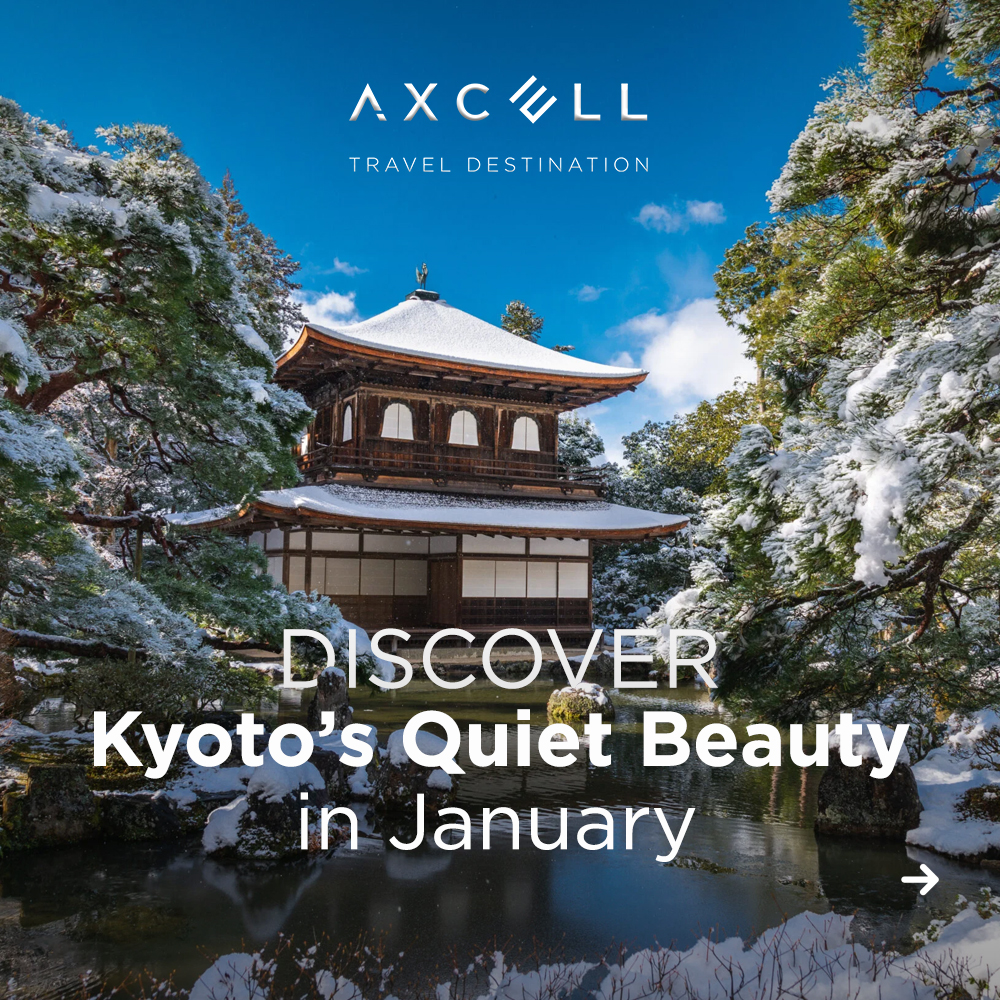
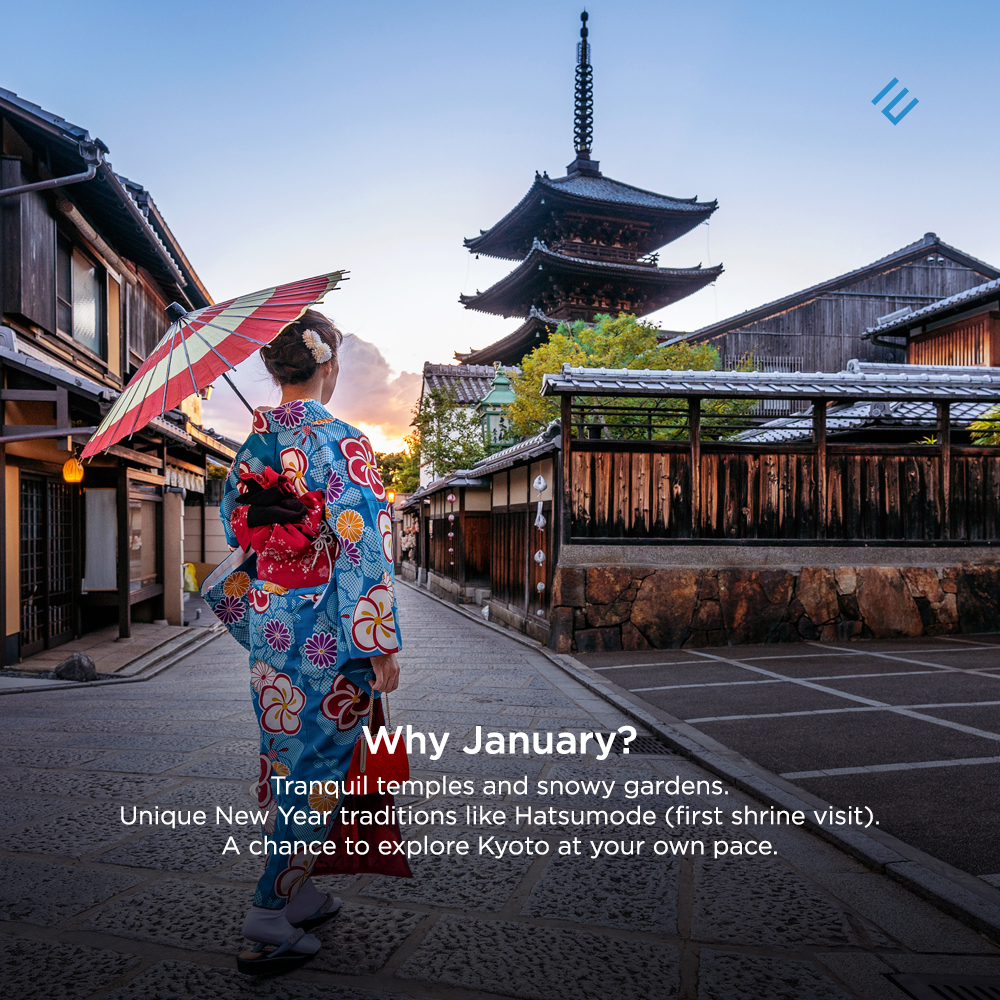
DISCOVER Kyoto’s Quiet Beauty in January

A Season of Stillness, Reflection, and Gentle Discovery

Travel does not always need spectacle to feel meaningful. Sometimes, the most powerful journeys happen in moments of calm—when crowds fade, sounds soften, and a place reveals itself without interruption. In Kyoto, January is such a moment.

Stripped of cherry blossoms, festival banners, and peak-season energy, Kyoto in winter returns to its essence. Temples breathe in silence, gardens rest beneath bare branches, and traditions unfold at a pace set not by visitors, but by time itself. This is a season for travelers who value depth over density, atmosphere over attraction, and presence over pace.

Below are the ways Kyoto’s quiet beauty emerges in January—through its weather, its rhythm, and its enduring traditions.

Weather Overview | Winter in Kyoto - A Different Kind of Comfort

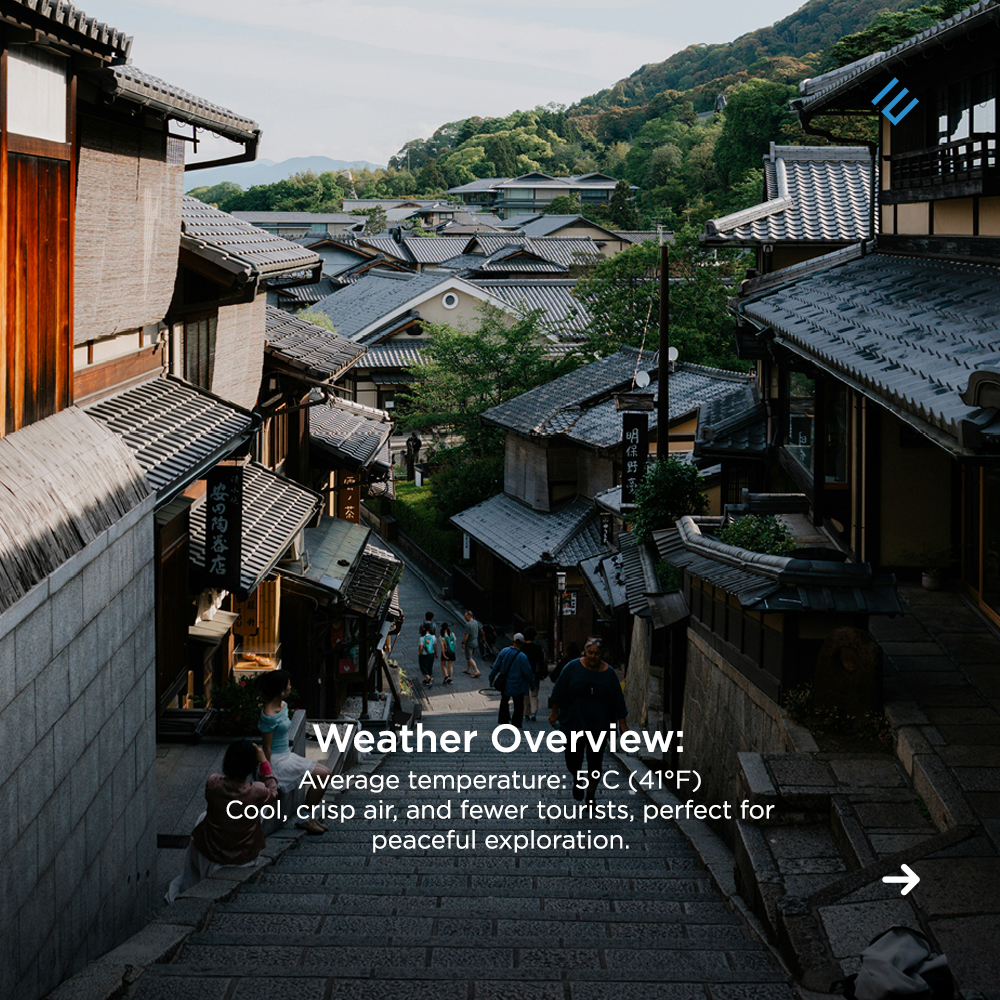
January in Kyoto is defined by clarity. With average temperatures around 5°C (41°F), the air feels crisp and clean, sharpening the senses rather than numbing them. Mornings often begin with pale light and visible breath, while afternoons are cool and bright, ideal for unhurried walks through temple grounds and historic neighborhoods.

Snow is not constant, but when it arrives, it transforms the city into something fleeting and deeply poetic. Rooflines dusted in white, stone paths softened by frost, and gardens momentarily suspended in stillness feel less like scenes to photograph and more like moments to witness quietly. Snow in Kyoto is never guaranteed—and that impermanence makes it all the more meaningful.

Light, Texture, and Awareness

Winter light in Kyoto sits lower in the sky, creating long shadows and gentle contrasts. Without dense foliage, architectural details come forward: the grain of wooden beams, the curve of tiled roofs, the careful placement of stones in gardens. The city feels more legible, more honest.

Cold weather also changes how you move. You pause more often. You seek warmth in tea houses, linger beneath temple eaves, and notice small details—steam rising from cups, incense smoke drifting slowly, the sound of footsteps on gravel. January encourages attentiveness, turning weather into an active part of the experience rather than a condition to endure.

Why January?

Temples Without the Crowd

The greatest luxury of January in Kyoto is space. With fewer visitors, temples regain their intended atmosphere as places of reflection rather than checkpoints. Courtyards feel expansive, halls echo softly, and silence becomes part of the architecture.

Gardens designed for contemplation reveal their winter character. Moss deepens in color, stones become more pronounced, and raked gravel patterns appear sharper and more deliberate. In the absence of lush greenery, the underlying philosophy of balance and restraint becomes visible. Winter does not diminish these spaces—it clarifies them.

A City at Its Natural Pace

January restores Kyoto’s natural rhythm. Shops open quietly. Neighborhoods feel lived-in rather than visited. Locals move without urgency, and travelers are free to observe rather than compete for space.

Without peak-season pressure, wandering becomes purposeful in a different way. You can walk without a destination, sit without an agenda, and leave gaps in the day unfilled. Kyoto rewards this openness. The city begins to feel cohesive—not a collection of famous sites, but a living whole shaped by daily routines.

Seeing Kyoto Between the Highlights

In January, the spaces between landmarks become as meaningful as the landmarks themselves. Residential streets, quiet shrines, neighborhood cafés, and early-morning markets reveal a side of Kyoto often missed. This is where the city feels most authentic—not curated, not rushed, simply lived.

For travelers seeking understanding rather than accumulation, January offers a Kyoto that feels deeply personal.

New Year Traditions - The Meaning of Hatsumode

January in Kyoto carries spiritual weight. The New Year is one of the most important moments in Japanese culture, marked by reflection, gratitude, and intention. Central to this season is Hatsumode, the first shrine or temple visit of the year.

Hatsumode is not a performance. It is a quiet, collective ritual. Families, couples, and individuals visit shrines to offer prayers for health, peace, and guidance. Bells are rung gently. Incense smoke curls into the winter air. Written wishes are tied with care, not urgency.

Participating Through Presence

For travelers, Hatsumode offers a rare form of cultural participation—one that does not require full understanding to be meaningful. Standing respectfully, observing rituals, moving with the flow of locals—these actions create connection without intrusion.

In Kyoto, this tradition feels especially grounded. As the cultural heart of Japan, the city offers a setting where spiritual practices are deeply embedded rather than symbolic. The atmosphere is calm and communal, blending personal reflection with shared purpose.

A Broader New Year Mindset

Beyond shrine visits, January in Kyoto reflects a broader cultural reset. Seasonal decorations are understated. Food traditions emphasize simplicity and symbolism. The year feels newly opened, like a blank page approached with care rather than urgency.

This approach reframes the idea of celebration. Renewal is not loud. It is intentional.

Kyoto, Understood Through Stillness

Kyoto in January does not announce itself. It waits. And in that waiting, it reveals a depth that busy seasons often conceal. This is the city without ornament—quiet, contemplative, and profoundly present.

Traveling here at this time invites a shift in mindset. You stop collecting moments and begin inhabiting them. You move less, but feel more. And in that stillness, Kyoto’s quiet beauty becomes unmistakable.

For those willing to embrace winter’s calm, January offers more than a visit to Kyoto.
It offers a deeper way of seeing—both the city, and the journey itself.

Thoughtfully Designed Journeys, Just for You

Start planning your thoughtfully designed journey with Axcell Travel Destination.

Where the World Welcomes 2025

Celebrating New Beginnings Across the Globe

The arrival of a new year is more than just a change on the calendar. It is a shared moment of hope, reflection, and renewal—one that unfolds differently across the world. As midnight travels from east to west, cities and cultures welcome the new year in their own unforgettable ways, blending tradition, spectacle, and collective joy.

From dazzling fireworks that light up iconic skylines to deeply spiritual rituals rooted in centuries-old beliefs, New Year celebrations reveal how humanity marks fresh beginnings with meaning and wonder. As 2025 approaches, the world once again becomes a stage for extraordinary moments—each destination offering a unique way to toast the future.

Here are three remarkable places where the world welcomes the New Year, each with its own rhythm, story, and spirit.

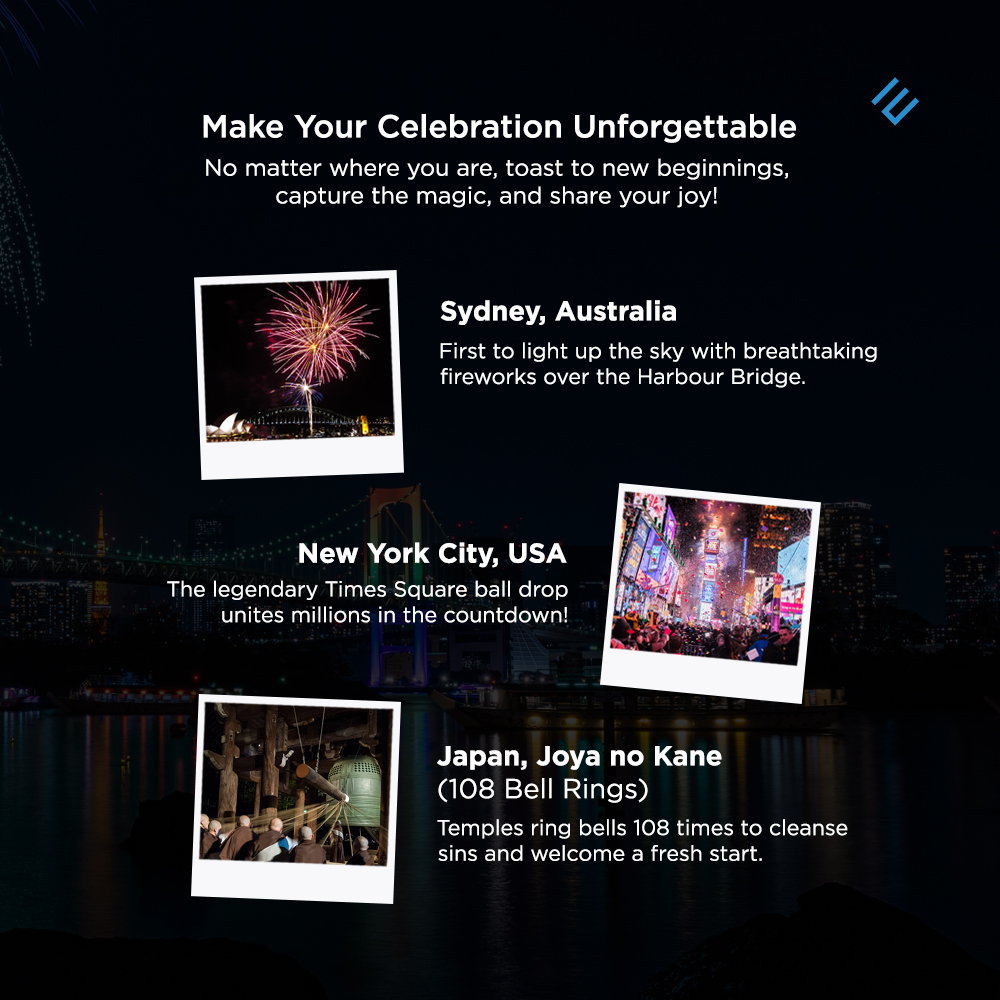
Sydney, Australia - First to Light Up the Sky with Breathtaking Fireworks over the Harbour Bridge

There are few places on Earth where the future arrives earlier than in Sydney. As one of the first major cities to cross into the New Year, Sydney holds a symbolic role—becoming the opening chapter of the world’s annual renewal. Long before midnight echoes elsewhere, Sydney has already stepped forward, carrying with it anticipation, optimism, and light.

The city’s geography plays a powerful role in shaping this experience. Built around a vast natural harbour, Sydney feels open and expansive, its skyline framed by water rather than walls. On New Year’s Eve, this openness becomes the perfect canvas for celebration. As darkness settles, the city gathers—quietly at first, then with rising energy—awaiting the moment when time officially turns.

At the heart of this transformation stands the Sydney Harbour Bridge, an architectural giant that becomes the focal point of one of the world’s most iconic fireworks displays. When midnight strikes, the bridge erupts in light. Fireworks arc across the sky in carefully choreographed sequences, cascading over the harbour and reflecting on the water below. Each burst feels deliberate, celebratory, and deeply symbolic.

But Sydney’s New Year’s Eve is not only about spectacle. It is about presence. Hours before the countdown, people gather along waterfronts, parks, and elevated lookouts. Conversations unfold, meals are shared, and strangers become companions in anticipation. There is a collective stillness just before midnight—a pause that feels almost sacred—before the sky ignites and the city exhales into the New Year.

Nearby, the Sydney Opera House glows beneath the fireworks, its sail-like silhouette anchoring the scene. Together, bridge and opera house form a visual language understood worldwide, instantly recognizable as a symbol of celebration, culture, and forward motion.

What makes welcoming the New Year in Sydney so meaningful is its emotional clarity. There is little irony here, little cynicism. The celebration feels sincere. Being among the first to enter a new year carries a quiet responsibility—to hope first, to imagine first, to begin again without hesitation.

As the final fireworks fade and the city settles into the early hours of January 1st, Sydney does not rush forward. Instead, it lingers in the afterglow—soft light on water, tired smiles, and the shared sense that something new has truly begun. It is not just a celebration of time, but a celebration of possibility.

New York City, USA The Legendary Times Square Ball Drop That Unites Millions

If Sydney opens the New Year, New York City defines it. Loud, emotional, crowded, and deeply symbolic, New York’s New Year’s Eve celebration is less about being first and more about being together. Here, the countdown is not simply observed—it is felt.

Every December 31st, the world’s attention gravitates toward Times Square, a crossroads of light, movement, and meaning. By late afternoon, the streets are already filled. People arrive layered in winter coats, carrying snacks, flags, and cameras, prepared to wait for hours just to witness a single moment.

The famous crystal ball—descending slowly as midnight approaches—has become one of the most powerful symbols of transition in modern culture. As it begins its final descent, the crowd counts together, voices merging into a single rhythm. In that moment, differences dissolve. Millions of individuals become one collective heartbeat.

When the clock strikes midnight, the city erupts. Confetti rains down, cheers echo between skyscrapers, and strangers embrace as if they have known each other forever. It is chaotic, overwhelming, and undeniably human. This is New York at its most honest—raw emotion layered over relentless energy.

What makes New York’s celebration so resonant is its inclusivity. People from every background, language, and belief system stand together, united not by tradition or ritual, but by shared anticipation. The ball drop is not ancient, yet it feels timeless because it speaks to something universal: the desire to mark change together.

Beyond Times Square, the city celebrates in quieter ways. Rooftop gatherings overlook glowing skylines. Jazz clubs welcome the year with music. Families toast at home, watching the countdown unfold on screens. Yet no matter where one stands, the pulse of the city remains unmistakable.

New York’s New Year’s Eve is not reflective like Japan’s, nor serene like Sydney’s afterglow. It is intense, emotional, and deeply collective. It reminds us that beginnings do not have to be quiet to be meaningful. Sometimes, they arrive loudly—carried by millions of voices counting down toward the same hope.

Japan, Joyanokane 108 Bell Rings to Cleanse the Past and Welcome a Fresh Start

In Japan, the New Year does not arrive with fireworks or countdowns. Instead, it arrives with sound—slow, resonant, and deeply intentional. Known as Joyanokane, this ancient Buddhist tradition offers a radically different way to cross the threshold into a new year.

As December 31st draws to a close, temples across Japan prepare for the ringing of bells—108 times in total. Each toll represents one of the earthly desires or negative emotions believed to cause human suffering: anger, jealousy, attachment, pride. The act of ringing the bell is not celebratory in the conventional sense; it is purifying.

The atmosphere surrounding Joyanokane is quiet and reverent. People gather in temple courtyards, often in winter silence, listening as the bell’s deep vibration travels through the air and into the body. There is no rush, no countdown shouted into the night. Time slows, allowing space for reflection.

What makes this ritual so powerful is its honesty. Rather than ignoring the burdens of the past year, Joyanokane acknowledges them. Each bell ring is an invitation to let go—not forcefully, but gently. By the final toll, the New Year arrives not as an explosion of excitement, but as a calm breath taken after release.

For travelers, witnessing Joyanokane can be profoundly moving. It reframes the idea of celebration, reminding us that renewal does not always require spectacle. Sometimes, it requires silence. Sometimes, it requires listening.

This tradition reflects a broader cultural philosophy in Japan—one that values balance, awareness, and intention. The New Year is not simply a new beginning; it is a continuation shaped by mindfulness.

As the final bell fades and the calendar turns, there is a sense of quiet rebirth. The world does not change instantly, but something internal does. And for many, that shift feels more lasting than any firework display.

Reflection

From Sydney’s radiant sky to New York’s unified countdown, and Japan’s soulful bells, the New Year reveals itself in many forms. Each destination offers a different answer to the same question: How do we begin again?

Some begin with light.
Some begin with voices.
Some begin with silence.

And in that diversity lies the beauty of travel—an opportunity not just to witness celebration, but to choose the meaning with which we welcome the year ahead.

Thoughtfully Designed Journeys, Just for You

Start planning your thoughtfully designed journey with Axcell Travel Destination.

Beyond the Tourist Trail | Cultural Experiences You Can’t Miss

Cultural Experiences You Can’t Miss

Travel becomes truly meaningful when it goes beyond famous landmarks and crowded routes. The most unforgettable journeys are often found in places where culture is lived daily—where traditions are not staged for visitors, but woven naturally into everyday life. From historic cities balancing old and new, to ancient towns preserving centuries-old customs, and remote islands where ancestral traditions still shape identity, these destinations invite travelers to experience culture in its most authentic form.

Below are three destinations that take you beyond the tourist trail, offering cultural encounters that stay with you long after the journey ends.

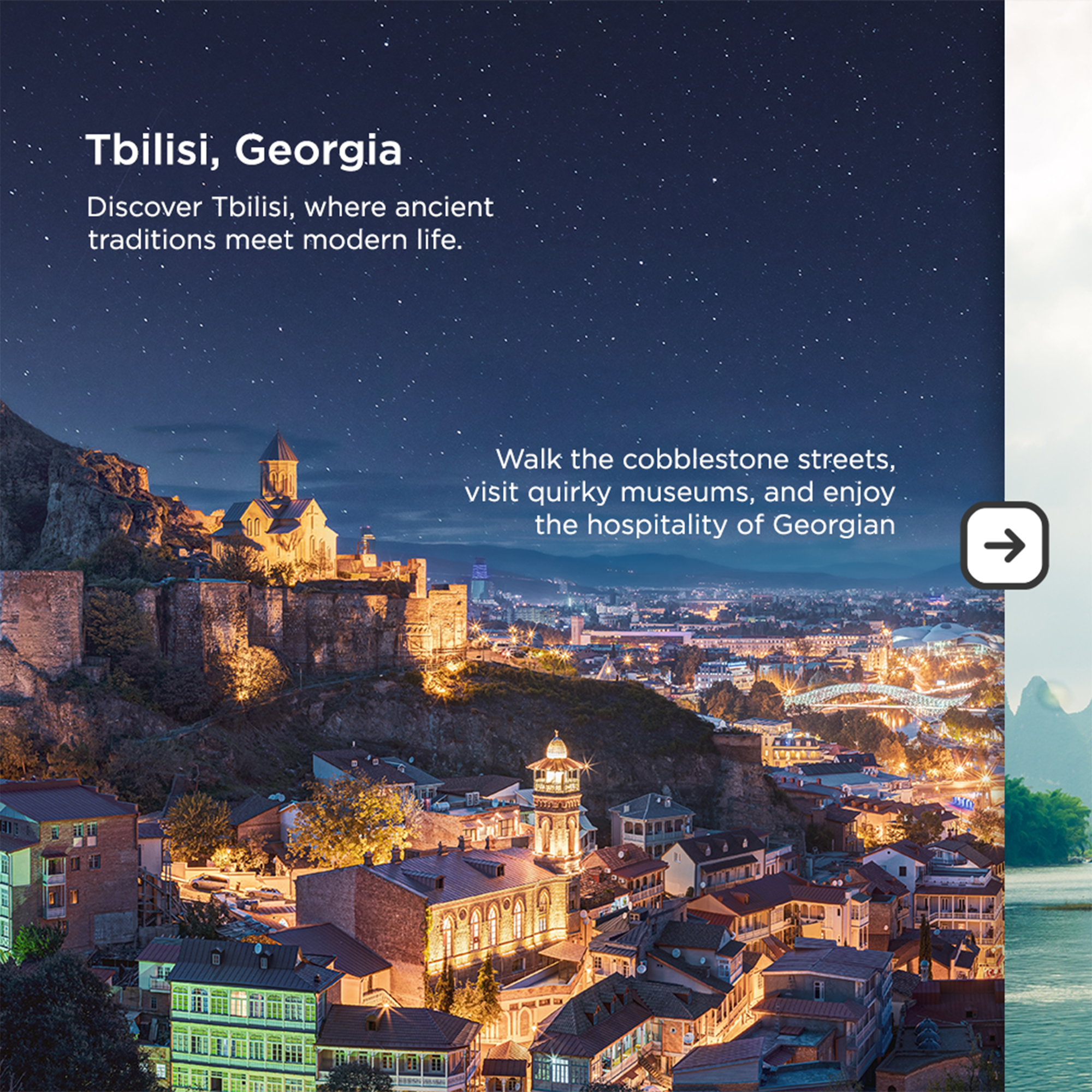
Tbilisi - A City Shaped by Layers of Culture

Set at the crossroads of Europe and Asia, Tbilisi is a city where history is not confined to museums—it lives openly in streets, homes, and traditions. For centuries, Tbilisi has absorbed influences from Persia, the Ottoman Empire, Russia, and Europe, creating a cultural identity that feels complex, warm, and deeply human.

Rather than hiding its contrasts, Tbilisi embraces them. Ancient churches stand beside Soviet-era buildings, while contemporary cafés and galleries flourish within centuries-old neighborhoods. The city feels raw, honest, and refreshingly unpolished—inviting travelers to engage rather than observe from a distance.

Walking Through Living History

Exploring Tbilisi on foot is the best way to understand its soul. Cobblestone streets wind through the Old Town, revealing wooden balconies carved with intricate patterns, pastel façades worn beautifully by time, and courtyards where daily life unfolds quietly.

Historic districts like Abanotubani, famous for its sulfur baths, reflect the city’s origins as a place of rest and renewal. Locals have gathered here for centuries—not just to bathe, but to talk, relax, and connect. Visiting these bathhouses isn’t a tourist ritual; it’s participation in a tradition that remains central to Georgian life.

Every step through Tbilisi feels layered, as if the past and present are walking alongside you.

Museums That Break the Mold

Tbilisi’s museums are as unconventional as the city itself. Instead of grand, formal institutions, many are intimate, personal, and reflective of Georgia’s complex identity. Small galleries highlight folk art, contemporary expression, and historical narratives that don’t shy away from hardship or resilience.

These spaces often feel like conversations rather than exhibitions. You leave not with facts memorized, but with perspectives expanded—understanding how Georgia’s history of invasion, survival, and independence shaped its cultural strength.

Georgian Hospitality - Culture at the Table

Perhaps the most powerful cultural experience in Tbilisi happens around the table. Georgian hospitality is legendary, rooted in the tradition of the supra—a communal feast guided by a toastmaster (tamada). Meals are long, expressive, and deeply symbolic, celebrating friendship, ancestry, and life itself.

Guests are treated not as outsiders, but as family. Toasts are thoughtful, emotional, and often poetic. Food becomes storytelling, and storytelling becomes connection. This openness transforms travel into relationship.

In Tbilisi, culture isn’t performed—it’s shared.

Why Tbilisi Goes Beyond the Tourist Trail

Tbilisi doesn’t try to impress—it invites curiosity. Its imperfections, contradictions, and warmth make it deeply real. Travelers leave not just having seen a city, but having felt one.

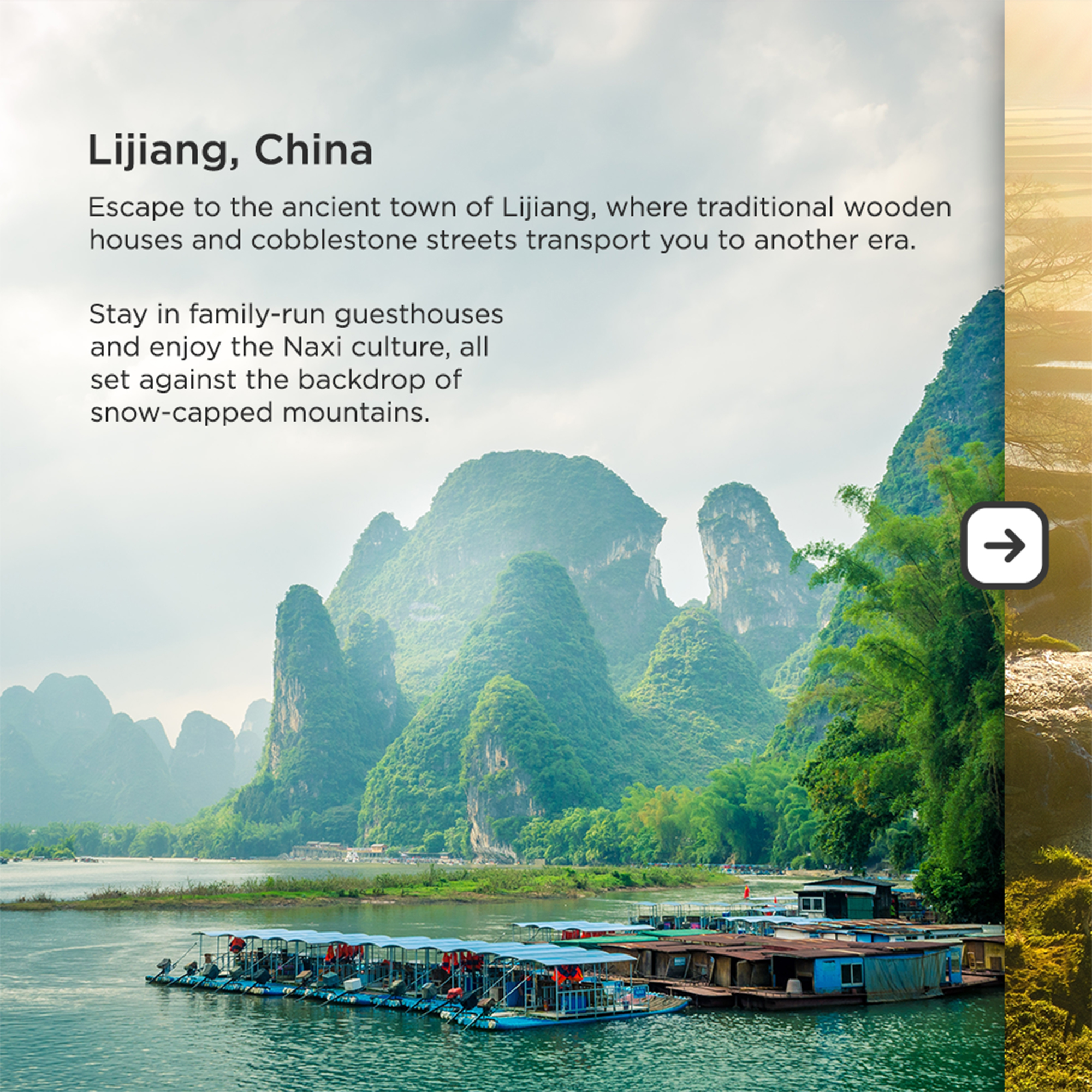
Lijiang - Stepping into Another Era

Nestled in the foothills of the Himalayas, Lijiang is a place where time seems to slow. Its old town, a UNESCO World Heritage Site, is a maze of narrow lanes, flowing canals, and traditional wooden houses that have stood for generations.

But Lijiang’s magic goes far beyond its beauty. What truly sets it apart is how deeply culture remains embedded in everyday life—particularly that of the Naxi people, an ethnic group with a distinct language, religion, and artistic tradition.

Living Among the Naxi Culture

Unlike destinations where culture is displayed for visitors, Lijiang allows travelers to live within it. Staying in family-run guesthouses offers insight into daily routines shaped by centuries of tradition. Hosts prepare meals, tend courtyards, and share stories that reflect a worldview centered on balance between humans and nature.

The Naxi people are known for their Dongba culture—a spiritual system expressed through rituals, art, and one of the world’s last pictographic writing systems. This cultural depth is not hidden behind glass; it exists in music performances, ceremonies, and everyday interactions.

Architecture with a Soul

Lijiang’s wooden houses are not decorative—they are functional, sustainable, and symbolic. Built to withstand earthquakes and adapt to mountain climates, they reflect architectural wisdom passed down through generations.

Cobblestone streets guide water naturally through the town, ensuring harmony between infrastructure and environment. This thoughtful design makes Lijiang feel alive rather than preserved—a town still serving its people, not just its visitors.

Mountains That Shape Identity

Rising dramatically in the background is Jade Dragon Snow Mountain, a sacred presence that influences Naxi spirituality and daily life. Snow-capped peaks serve as a constant reminder of nature’s power and beauty.

The relationship between town and mountain reinforces a cultural philosophy centered on respect, balance, and coexistence. In Lijiang, landscape is not scenery—it is identity.

Why Lijiang Feels Authentic

Despite its fame, Lijiang retains intimacy when approached thoughtfully. Early mornings and evenings reveal quiet rhythms, when locals reclaim streets and canals glow softly under lantern light. This is when the town feels most genuine.

Lijiang offers travelers not spectacle, but immersion—an invitation to step into a culture that remains deeply rooted and gracefully lived.

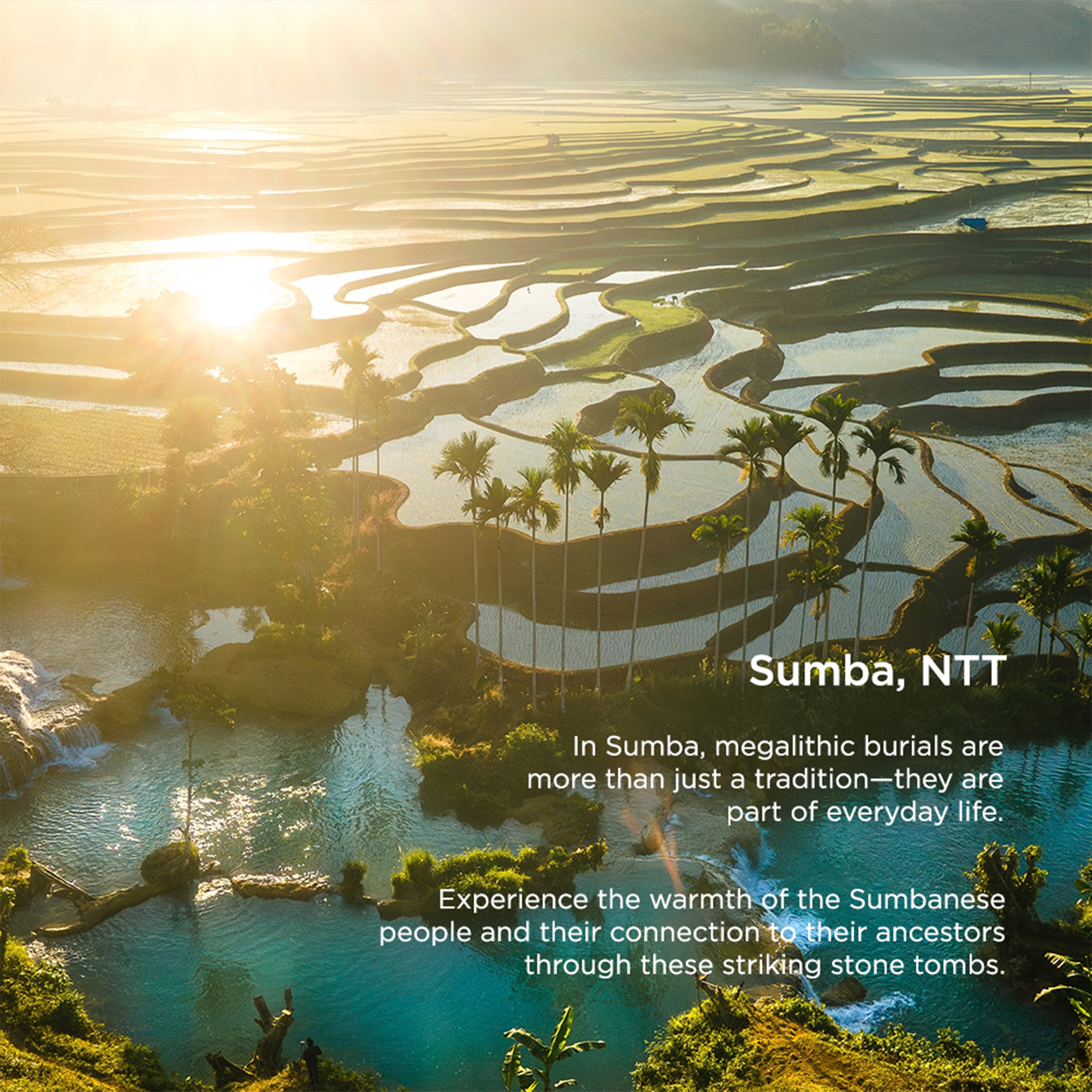
Sumba - A Living Dialogue with the Ancestors

On the eastern edge of Indonesia lies Sumba, an island where tradition is not something remembered—it is something lived. Here, towering megalithic tombs dominate village landscapes, standing as physical expressions of ancestral reverence and social identity.

In Sumba, the past is not distant. It walks beside the present.

Megalithic Burials as Everyday Life

Unlike archaeological sites elsewhere, Sumba’s stone tombs are part of daily surroundings. They are built in village centers, beside homes, and within sight of everyday activities. These structures represent lineage, honor, and the enduring bond between the living and the dead.

Funeral rituals are among the most important cultural events, often planned years in advance and involving entire communities. These ceremonies are not spectacles—they are sacred transitions rooted in belief, respect, and continuity.

Witnessing these traditions offers rare insight into how culture shapes identity beyond modern timelines.

Warmth Beyond Infrastructure

Sumba may feel remote, but its people are profoundly welcoming. Visitors are greeted with openness and curiosity, often invited into homes and ceremonies. Conversations may happen through gestures, smiles, and shared moments—but the connection feels genuine.

Life here moves slowly. Time is measured not by schedules, but by seasons, rituals, and community needs. For travelers, this shift in pace can be deeply grounding.

Tradition in Motion

Cultural expressions in Sumba are dynamic. Events like the Pasola ritual—where mounted warriors engage in ceremonial combat—reflect values of courage, balance, and spiritual harmony. Music, weaving, and architecture all carry symbolic meaning tied to ancestry and environment.

Every tradition reinforces a worldview where humans, land, and ancestors are inseparable.

Why Sumba Transforms Travelers

Sumba challenges modern assumptions about progress, success, and time. It invites travelers to reconsider what it means to live with purpose and connection.

This is not an easy destination—but it is a profound one.

These destinations—Tbilisi, Lijiang, and Sumba—offer something increasingly rare in modern travel: authentic cultural immersion. They don’t exist to entertain. They exist to be understood.

Traveling beyond the tourist trail means accepting discomfort, slowing down, and listening. The reward is deeper than photographs—it is perspective.

If you’re seeking journeys that change how you see the world, these are cultural experiences you truly can’t miss.

Thoughtfully Designed Journeys, Just for You

Start planning your thoughtfully designed journey with Axcell Travel Destination.